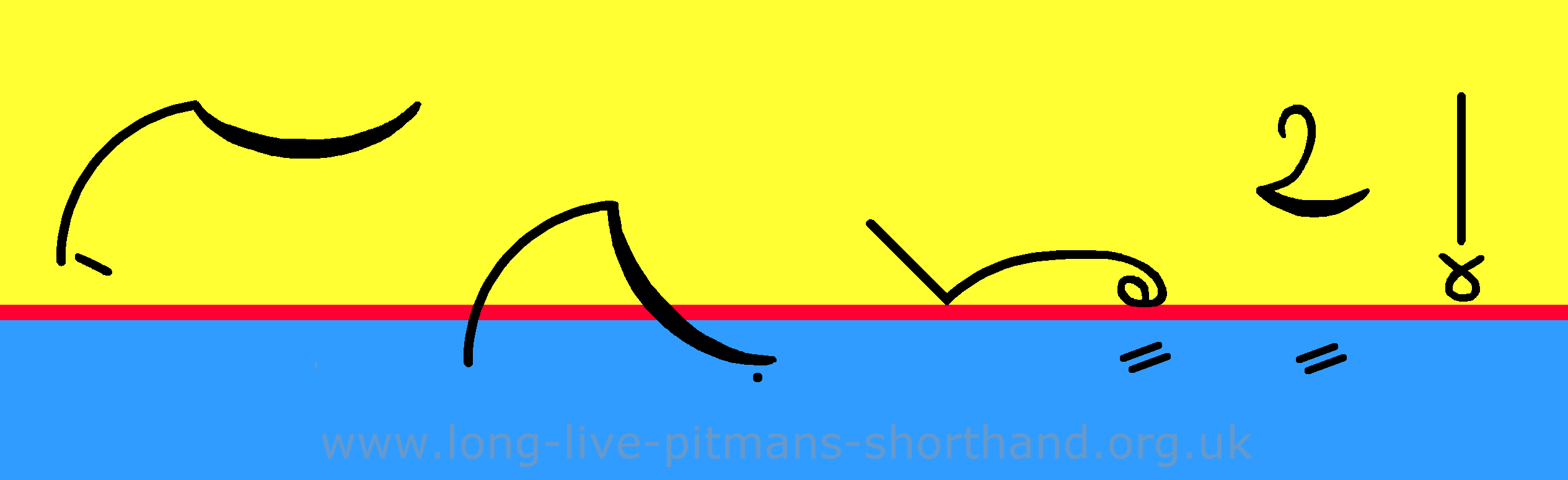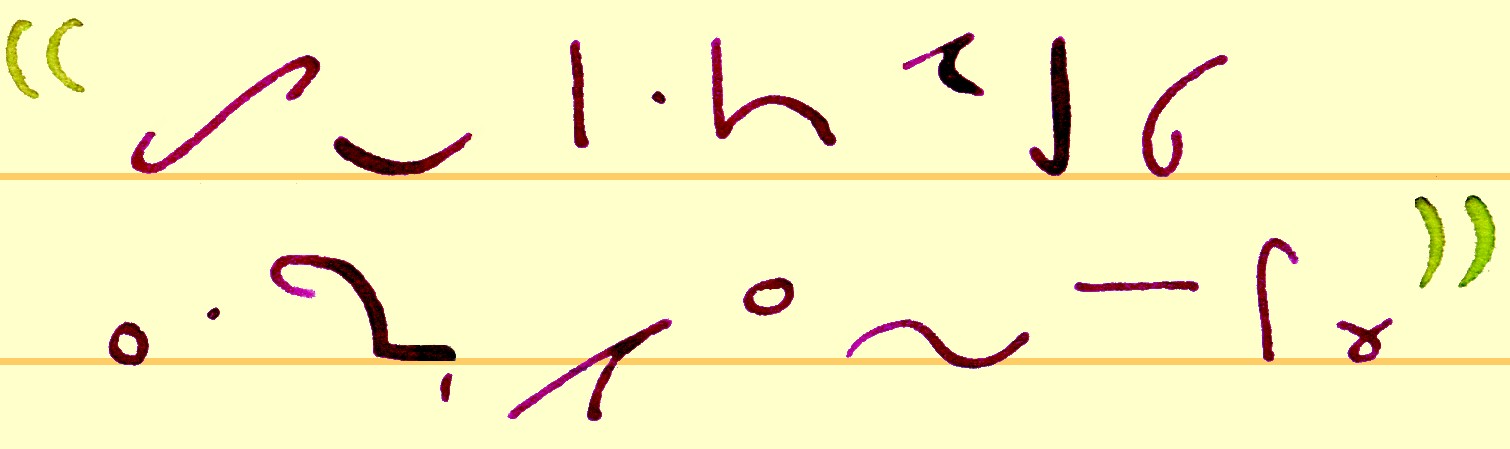
"One thing at a time and
that done well is a very good rule as many can tell."
Short Forms are outlines of one stroke or one vowel sign, used for
the commonest words. They are not full outlines, but they always use
one of the sounds of the word. They are a fixed part of
the system, to be learned and practised. The short-term work
involved in learning is vastly outweighed by the permanent advantage gained
in brevity and speed. As they are such common words, they quickly
become second nature as study progresses, and the beginner should
not be daunted by viewing what seems to be a long list.
Half the words of normal speech/text consists of 47
short forms, 20 single-stroke outlines and 2 double-stroke outlines.
The 9 most frequent of these make up a quarter of speech: the,
of, and, to, a, in, that, it, is. Learning them thoroughly is
well worth the effort.
Short forms are not vocalised. In phrases, only
four
of them need to have a vowel (go, him, own, those) for clarity, because
they are out of position. When a short form has another stroke or
outline added to it (e.g. dearer, chairman), the short form must
retain its original position. The remainder of the outline may be
vocalised but the short form part remains unvocalised.
There are two other names for the short form outlines which you
may find in teaching books:
- Logograms
- Word Forms or Wordsigns (American)
The English word itself (not the outline) is sometimes referred
to as a grammalogue, i.e. a word that is represented by a short form.
The reason for this is to differentiate between words that are
identical in sound, and sometimes in spelling, but different in
meaning:
- "Till" meaning "until" is a
grammalogue, as
it is represented by a
short form.
- "Till" meaning "work the soil" or "cash register" is not a
grammalogue and has a full vocalised outline.
Other pairs are more obvious, such as "be" and "bee" or "you" and
"ewe". The second of the pair is clearly not a common word
and the use of a short form would be more of a hindrance than
a help.
In the same way, short forms are not generally
used for personal or place
names e.g. Mr Short, or Wye Valley. Names should be formed with full
outlines, and clearly vocalised wherever possible. In this respect the form of the
outline
relates to the meaning of the word, not just its sounds, and
this is therefore a small departure from the phonetic basis
of the system. The reason for this is that no amount of context would
help you to read back a personal name, if it were written using a
short form. Legibility is the top rule here.
Shortened outlines of more than one stroke are known as
contractions.
One might think that all the derivatives
would be based on the original short form, but this is not always
the case. For this reason, I have given a selection of derivatives,
related and similar words. Hopefully this will save you from hastily writing a
short form and then trying to add bits on to it, when another
outline altogether is called for. It is generally safe, however, to
add circle S to any short form. You would benefit from adding to the
list of additional words, in order to build up your study material
library.
All the short forms of the system are shown, in stroke order,
as it is more helpful to study them in batches of the same stroke,
but there is
only a selection of derivatives. Some short forms do not seem to
have any obvious derivatives. The short forms list is now fixed, as
far as textbooks go, although some of them are less common and would
probably not make it onto the list if it were being created today, e.g. shalt, aye, aught,
Lord, but I have
kept the list complete.
In dictation, if you do not know or cannot recall the short form,
then you should never hesitate to write a full outline of some sort – red pencil it during
transcription and learn the short form as soon as possible. Knowing
that you are thorough about correcting your shorthand will enable
you to write a "wrong" form without wavering. You should be
doing this all the time with any new words that require
attention/dictionary delving, and keeping a notebook of items to
practise.
I have split the list over 4 pages, as there are a
large number of jpgs involved. The short forms are available in the
folded booklet PDF and as JPGs (suitable for phone/Ipod) from the
Downloads page. I will provide the complete list that includes
the derivatives as a PDF for ease of download at a later date. You can easily clipboard the tables, and produce the
list in alphabetical order – but keep a separate copy in stroke
order as well!
Short Forms List 1 – Strokes: P B T D
Short Forms List 2 – Strokes: Chay J K Gay
Short Forms List 3 – Strokes: F V Ith Thee
Short Forms List 4 – Strokes: Circles Zee Ish Zhee M N L Ar Ray Way
Vowels
Top of page
|