Long Live Pitman's Shorthand banner text

Completely devoted to New Era Shorthand


Shorthand Reading Photo Tour – Greenwich Part 1

Long Live Pitman's Shorthand! Free resources

Visit my BlogSpot written in shorthand


Search this website.
Results by
Freefind
Advanced

Or use my Search Page - 1000's of outlines on this site

Home   

Recent Additions

About

Shorthand Everywhere

Why Learn?

Notes for Beginners

Pen and Paper

Pen & Pencil Reviews

Dictation

How To Practise

Downloads

Blogspot Archive PDFs

Links

Guestmap & Guestbook links page

Theory
 
Intro
 1   Strokes
 2   Vowels
 3   Forming Outlines
 4   Circles
 5   Loops
 6   Hooks Intro
 7   Hooks R L
 8   Hooks N F V
 9   Shun Hook
10  Halving
11  Doubling
12  Hay Aspirate
13  W Forms
14  L Forms
15  R Forms
16  Imp/Imb
17  Ish
18  Prefixes
19  Suffixes General
20  Suffixes Contracted


Short Forms
Intro
SF List 1
SF List 2
SF List 3
SF List 4

Contractions
Contractions Intro
Contractions Main

Contractions Optional

Phrasing

1 Intro & Contents list
2 Theory
3 Theory
4 Omission
Part words
5 Omission
Whole words
6 Miscellaneous
7 Miscellaneous
8 Intersections

Distinguishing Outlines
DO Intro
DO List 1 A-C
DO List 2 D-H
DO List 3 I-P
DO List 4 Q-Y

Vocabulary
Intro
Numbers
Punctuation
Shorthand Dictionaries

Word Lists
Text Lists from PDFs

Yellow Teddy

Pitman's New Era Shorthand Reading Pages

Reading Intro + PDF List
About Shorthand
Shorthand Speed
Calendar Quotes
Bible
Christmas Carols
Faith 1: Christmas Story

Kent Places
Miscellaneous 1

READING PHOTO TOURS:
Garden

Hastings, East Sussex
Greenwich Part1
Greenwich Part2
Greenwich Part3
Greenwich Part4
Greenwich Part5
Greenwich Part6

Long Live Pitman's Shorthand! logo web


I lived in Kidbrooke and Blackheath for over 20 years, passing the Queen's House and the Cutty Sark every day on the way to school in Greenwich. Kings and queens of England enjoyed this park, I visited it regularly whilst I lived there, and I hope you will do the same through these pages.

I am absolutely delighted that the shorthand dictionary gives the correct pronunciation of Greenwich, i.e. "grinnidge". The shorthand is completely vocalised, apart from the occasional phrase where it would be obtrusive or change the meaning.  If you use the paragraphs for practising, you should leave most of the vowels out.

Notes on the outlines are given after some of the paragraphs. The notes below refer to items occurring on several Greenwich pages:

  • direction: can also be pronounced with short I
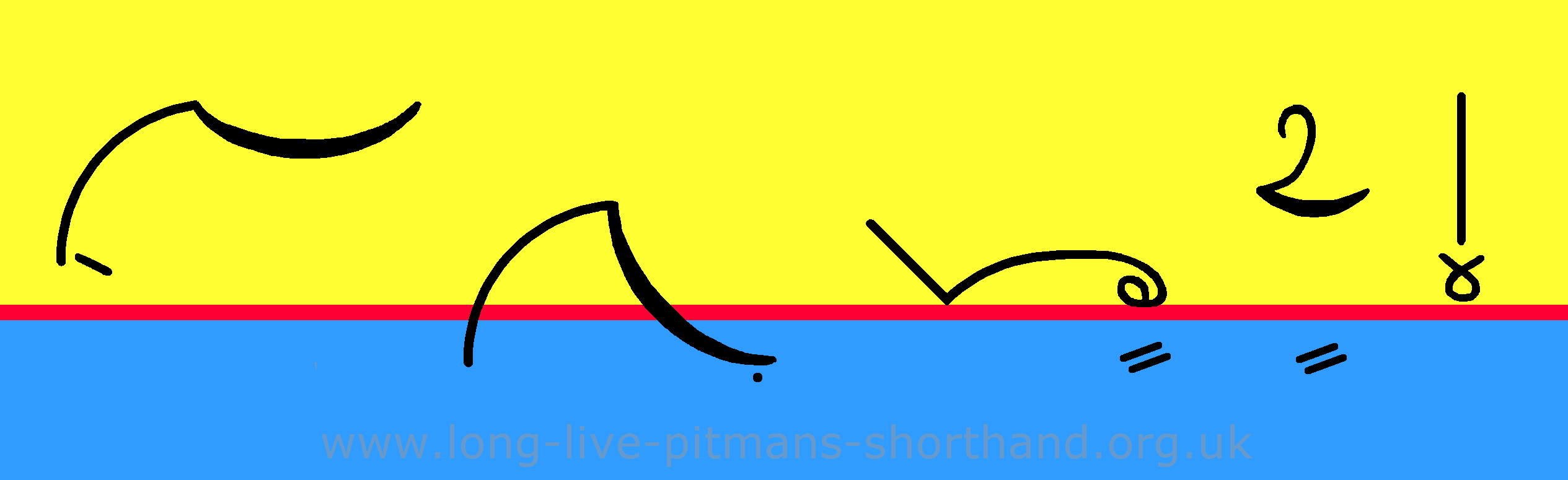
    Pitman's New Era: direction x 2

  • ornament, ornamental: these are exceptional, using Ray to get convenient outlines

  • Pitman's New Era: ornament ornamental

  • in fact, by the fact that, and the fact that these: omitting the F in "fact" only occurs in phrases, and makes a saving of 2˝ strokes
    Pitman's New Era: in fact, by the fact that, and the fact that these

  • part of, instead of, rather than, later on: as these are phrases, using the hook for "of/than/on" breaks normal rules in being pronounced after the halving
    Pitman's New Era: part of, instead of, rather than, later on

  • altitude/latitude: see Distinguishing Outlines List 1

  • human: see Distinguishing Outlines List 2 human/humane

  • favourite: see Distinguishing Outlines List 2 favoured/favourite

  • do not, does not, did not, cannot, were not (using "were" halved), here is, she is, they have: these are left unvocalised. If a vowel were inserted, these outlines would then mean the apostrophe version i.e. don't, weren't, here's, they've etc.

  • ship = she: English language students should be aware that ships are traditionally referred to as "she" not "it"

  • at one time, sometime, sometimes: the previous stroke is halved for the T of "time" = "at-wunt-ime, sumt-ime, sumt-imes"

  • ... = three dots, called an ellipsis, denotes intentionally missing text. There is no separate shorthand sign for this, so a wavy underline alerts you to what it is. Three shorthand crosses would be too time-consuming.

Introduction, map thumbnail, Blackheath, General Wolfe, South Building, Planetarium, Altazimuth Building, Onion Dome

View from Greenwich Park over the Thames to Isle of Dogs

Pitman's New Era Shorthand Reading: Greenwich para 1

1. Greenwich Park lies on an escarpment on the south side of the River Thames, six miles east of the City of London. The southern end of the park is on the flat land at the top of the scarp with views of the entire sweep of the river and northwards. The land continues down the hill to river level. There has been a royal residence here since before 1300. The Manor of Greenwich was owned by King Henry IV and King Henry V. The park itself began when the Manor was inherited by the Duke of Gloucester, who gained permission to enclose 200 acres. He built Bella Court Palace and the tower of Greenwich Castle on the hill. On the Duke's death, the Manor estate reverted to the Crown. King Henry VII rebuilt and renamed Bella Court as the Palace of Placentia or Pleasaunce, which means pleasure garden. King Henry VIII was born here, as were his daughters Mary I and Elizabeth I. (169 words)

Map of Greenwich Click thumbnail for larger photo of notice board map of Greenwich

Greenwich Park - Blackheath Gate Greenwich Park - Gate Lodge

Pitman's New Era Shorthand Reading: Greenwich para 2

2. Blackheath Gate is on the south side of the park, facing the expanse of the heath. This is best known nowadays as the starting point of the London Marathon which takes place every April. The runners form their huge queue in the long avenue in the park and the marathon route turns left outside the gate and makes for Charlton and Woolwich. There the route doubles back on itself, passing the park again on the lower road through the town of Greenwich, making a detour over to the Isle of Dogs and finishing in The Mall by St James's Park. The route thus goes from a former royal residence to the present one at Buckingham Palace.

Just inside is the Gate Lodge built in 1851 for the keeper of the park, to replace the 17th century Keeper's Lodge that was in the middle of the park. It is decorated in the ornate Victorian style, with multicoloured brickwork and intricate floral bargeboards. The top half is faced with buff-coloured glazed tiles in a diamond pattern and the roof has alternating courses of plain and fish-scale tiles. It was designed by John Phipps who gave it an additional Tudor flavour with the timber jetty and beams at the front. It is not presently part of the amenities but it is nevertheless a fitting ornament to welcome visitors to the royal park. The plainer buildings opposite the Gate Lodge are the park and police offices, where visitors can obtain information and literature on the park. (252 words)

  • takes place: ensure the central hook shows clearly

  • Buckingham: the H is not pronounced

  • board: on its own this has full strokes Bee + Ard

Blackheath and Shooters Hill

Pitman's New Era Shorthand Reading: Greenwich para 3

3. Here is Blackheath Common just outside the main park gates and this view shows about a third of the large area of flat grassland. Blackheath means "dark coloured heathland". The heath was a barren wilderness and not used for farming, but the stony soil was dug for ballast and gravel. After the Second World War, most of the diggings were filled in with rubble from bomb-sites and the common is now level, apart from a small area of dips and undulating ground at the north-east corner, called Vanbrugh Pits, and a similar area in the opposite corner of the heath called Eliot Pits.

Blackheath was one of the rallying places for the Peasants' Revolt led by Wat Tyler and the rebellion headed by Jack Cade, both of whom have roads named after them on the south-west side of the heath. In the 17th and 18th centuries, stagecoaches crossing the heath were at the mercy of the notorious highwaymen and it was not the safe and pleasant place that we know today. The heath has always been a natural meeting point and today is used for recreation, football, sports, firework displays, kite flying, funfairs and other events. The edge of Blackheath Village is on the right of the photo.

In the background is Shooters Hill, named from the archery practice that took place there in the Middle Ages. The Victorian water tower at its summit can be clearly seen from all the surrounding countryside. The tower is situated directly on Shooters Hill Road and is still in use by Thames Water. On the south-west side of Shooters Hill is Oxleas Wood, one of the few remaining pieces of ancient deciduous forest, which is estimated to be over 8,000 years old. Jack Wood and Castle Wood are visible in the photo, and Oxleas Wood, Oxleas Meadows and Shepherdleas Wood are on the other side of the hill. (315 words)

  • stony: essential last vowel, as "stone" would also make sense

  • Eliot: Tee in full because it is a name

  • 8,000: Keep the Ith well curved, so that it does not look like 81

  • on the oth(er) side of the: the R of "other" omitted

www2.lewisham.gov.uk/nature_conservation/Blackheath%20Park%20extra%20text.htm About Blackheath, in particular the wild plants

Duke Humphrey Road, Blackheath and granite path

Pitman's New Era Shorthand Reading: Greenwich para 4

4. This length of granite sett pavement is in Duke Humphrey Road just outside the main gates, used for many years for donkey rides which are still offered at weekends and holiday periods. It is fitting that the road named after the creator of the park is directly opposite the main entrance gates. On the right of the granite path can be seen the stony nature of Blackheath soil, a reminder of its past as a wilderness covered with gravel diggings, a danger for the unwary traveller who strayed from the established trackways. The sharp spire of All Saints Church in Blackheath Village is in direct line of sight, although the road is short and does not cross the heath to reach the church. The sharpness of the spire led to its being dubbed the Needle of Kent when it was first built. (142 words)

  • stony: essential last vowel, as "stone" would also make sense

www.newsshopper.co.uk/news/2001189.donkey_mans_diamond_milestone News article from 2008 about the Len the Donkeyman who ran the donkey rides for many years.

Some extra practice to help with distinguishing outlines:

Ride on creatures next to the gravel craters along a road named after the park's creator.

Greenwich Park - Blackheath Avenue Greenwich Park - Statue of Major General James Wolfe

Pitman's New Era Shorthand Reading: Greenwich para 5

5. Blackheath Avenue leads from the gatehouse northwards through the park to the edge of the hill, and ends with the statue of General Wolfe. The inscription on the back of the statue reads, "This monument the gift of the Canadian people was unveiled on the fifth of June 1930 by Le Marquis de Montcalm". Major General James Wolfe lived in Macartney House in Greenwich Park and started his military career at the age of 13. He led the battle in 1759 that ended French control of Quebec, which paved the way for the English to gain control of Canada from the French. He died in that battle at the age of 32 on the Plains of Abraham, and is buried in St Alfege Church in Greenwich. Immediately in front of the monument is the viewing area, with seats and public telescopes overlooking the grassy slope down to the Queen's House, the River Thames and the panoramic views of North London. (160 words)

  • monument: can't place the U diphthong sign against the final halved En because here that stroke represents "ment"

  • Marquis & Montcalm: the outlines use the English pronunciation

Greenwich Park - South Building Greenwich Park - South Building, bust of John Flamsteed

Greenwich Park - South Building - name Flamsteed Greenwich Park - South Building - name Halley Greenwich Park - South Building - name Bradley

Pitman's New Era Shorthand Reading: Greenwich para 6

6. At the end of Blackheath Avenue are the buildings that comprise the Royal Greenwich Observatory. This is the South Building which was completed in 1899 as an astrophysics observatory. Over all the first floor windows imprinted in terracotta brick are the names of notable scientists and astronomers. The bust on the pediment is John Flamsteed, the first Astronomer Royal, and his name appears over the entrance below. Edmond Halley was the second Astronomer Royal. He noticed that four previous comets had the same orbit, and concluded that these were just one comet and that it would be seen again in 1758. He died in 1742 but when the comet returned as predicted, it was named after him. Halley also has a lunar crater and a Martian crater bearing his name, as well as Halley's Method for the numerical solution of equations. James Bradley was the third holder of the post and is known for the discovery of the "Aberration of Light" which further proved the theory, first proposed by Nicolaus Copernicus, that the earth was in motion and therefore not the immobile centre of the universe. This enabled Bradley to improve the accuracy of the existing estimate of the speed of light. (202 words)

  • notable: See Distinguishing Outlines List 3 noble/knowable/notable

  • aberration: essential first vowel, as the outline is similar to "operation" which would also make sense

  • proved the: The vowel would normally go at the very end, but is moved inwards because of the tick

  • Nicolaus: using German pronunciation, compare the English Nicholas in para 65, Part 5

Greenwich Park - South Building - ship weather vane Greenwich Park - South Building - ship weather vane and airplane

Pitman's New Era Shorthand Reading: Greenwich para 7

7. This is the ship weather vane on top of the South Building and is a depiction of the Great Harry, Henry VIII's flagship built at Woolwich Dockyard. She carried heavy and light guns, and bronze cannon, and was the first English two-decker gunship, and had a crew of between seven hundred and a thousand. She suffered problems from being top-heavy and was later restructured to improve performance. The weather vane is a reminder that the astronomical work carried on here was principally to improve navigation at sea, both military and trading. The little vertical blobs on the weather vane are not figures but turret-like structures. The ship's crew are obviously still waiting patiently for the astronomers to deliver their completed accurate star-maps and timetables, so that they can undertake their next voyage in safety and return home successfully without loss. Meanwhile, they are bemused by the fact that they are constantly facing into the wind, instead of having it behind them filling their sails. What would they have made of the strange metal bird overhead, descending on its flight path for landing at Heathrow Airport? (186 words)

  • Heathrow - the strokes reflect the separate parts heath+row. 
    Pitman's New Era: Heather Hither
    Avoid using hooked Ith, as that would be too similar to the name Heather or Hither

Greenwich Park - South Building - astronomy film Greenwich Park - South Buiilding - copy of Isaac Newton's Principia

Pitman's New Era Shorthand Reading: Greenwich para 8

8. Entry to the South Building is free and you can visit several astronomy galleries, many of which have interactive displays. A darkened room shows a looping film on three large screens, describing the story of the beginning of the universe, as understood by present-day scientists, a free taster of what might be enjoyed on a much larger scale in the main planetarium, which is accessed from this building. There are two soft benches for about 16 people, plus plenty of standing room. The item lasts about 5 minutes and is accompanied on screen by the text of the narration and signing for the deaf. You can also see and touch a 4.5 billion year old meteorite that landed in prehistoric times in Namibia.

Isaac Newton was a good friend of Edmond Halley who encouraged and helped him to publish his treatise "Mathematical Principles of Natural Philosophy". It was published in 1687 and contains his statement of the laws of motion and the law of universal gravitation. A copy of the 1713 edition is displayed in the museum and the caption reads "This book is a copy of Newton's Principia*, one of the most important mathematical works ever published. It is said to be bound in leather taken from one of his chairs. In this revolutionary work, Newton explains his theory of gravity, a breakthrough in scientific thinking that still underpins our view of the universe today." (236 words)

*Latin = Philosophiae Naturalis Principia Mathematica

  • of the (be)ginn(ing): "beginning" can be intersected or written close up to the preceding outline

  • taster: ensure the Ster Loop is large, as "taste" would also make sense

  • accessed: using stroke Ess for access allows derivatives, compare with "exist"
    Pitman's New Era: access accessed exist existed
    access accessed exist existed

  • Principia: with hard K to follow traditional Latin pronunciation - the book was written in Latin with Latin title

  • one (of the) most: contracted phrase

  • it is said: the Ses Circle represents both S's

Greenwich Park - South Building - astronomy display

9. Some of the quotations displayed around the museum:

Pitman's New Era Shorthand Reading: Greenwich para 9A

  • “Astronomy compels the soul to look upwards and leads us from this world to another.” Plato (428 BC – 348 BC)

  • “Nothing in the entire universe ever perishes … this thing may pass into that, and that into this, yet the sum of things remains unchanged.” Ovid (43BC – 17AD)

  • “The earth is round and is inhabited on all sides: it is insignificantly small and is borne through the stars.” Johannes Kepler (1571-1630)

  • “To myself I am only a child playing on the beach, while vast oceans of truth lie undiscovered before me.” Sir Isaac Newton (1642-1727)

 (86 words, excluding dates)

  • borne: note the vowel. Variations shown below
    Pitman's New Era: born borne bourn/bourne
    born (as in birth), borne (=carried), bourn/bourne (=small river or stream)

  • Johannes: for the German pronunciation, use Yay instead of Jay
    Pitman's New Era: Johannes

Pitman's New Era Shorthand Reading: Greenwich para 9B

  • “I have looked further into space than ever a human being did before me.” William Herschel (1738-1822)

  • “A quarter of a century ago astronomy was little more than celestial topography.” George Phillips Bond (about 1826-65)

  • “The important thing is not to stop questioning.” Albert Einstein (1879-1955)

  • “The history of astronomy is the history of receding horizons.” Edwin Hubble (1889-1953)

 (54 words, excluding dates)

  • human being: "being" uses the short form "be", so the "ing" has a dot, not a diphone

  • celestial: omits the T

Greenwich Park - Peter Harrison Planetarium

Pitman's New Era Shorthand Reading: Greenwich para 10

10. The Peter Harrison Planetarium was opened in 2007 with a 120-seat auditorium and a digital display projector. The building is a truncated cone, made of concrete for sound insulation and clad in bronze plates welded together and artificially patinated to a smooth dull mottled appearance, said to resemble the nebulae seen in photos of deep space. The building is tilted at approximately 51.3 degrees, the same as the latitude of Greenwich, and is also placed on the meridian line. The project was funded by the Peter Harrison Foundation, a charitable trust named after its founder, and not connected with John Harrison the inventor of the marine chronometers. (107 words)

  • 120-seat: ensure the circle is on the correct side; the circle written clockwise would mean "120-seater"

  • nebulae: plural, essential last vowel, to distinguish it from the singular "nebula"

Greenwich Park - Altazimuth Building

Pitman's New Era Shorthand Reading: Greenwich para 11

11. Next to the planetarium is the Altazimuth Pavilion, constructed in 1899 to house astronomical instruments to measure the altitude and azimuth of celestial bodies. Altitude is the height of a star above the horizon measured in degrees and azimuth is its position eastwards from due north. Azimuth is sometimes known as a bearing and can be thought of like a circular clock face on the ground with the observer at the centre, with due north being 12 o'clock and the star's position being read as one of the other times e.g. 90 degrees would be 3 o'clock. Inside the building are wall boards with astronomy displays but no equipment is to be seen.
(113 words)

  • celestial: omits the T

Greenwich Park - Altazimuth building weather vane of Halley's Comet Greenwich Park - Altazimuth building, closeup of weather vane Greenwich Park - South Building - "Astronomia" plaque comet

Pitman's New Era Shorthand Reading: Greenwich para 12

12. The weather vane on the dome is Halley's Comet and its design is based on the picture of it in the Bayeux Tapestry, a fiery ball with a fantail. The comet's appearance in 1066 was viewed with great fear, as comets were generally considered omens of disaster. Another comet appears next to the figure Astronomia on the ground floor, although this could possibly be a meteor. (66 words)

  • Bayeux: the thick dash written sideways to the stroke represents this French vowel, as heard in English "sir"

http://en.wikipedia.org/wiki/Bayeux_Tapestry shows closeup picture of the embroidered comet

Greenwich Park - Onion Dome  Greenwich Park - Onion Dome visual refractor Free entry to dome

Pitman's New Era Shorthand Reading: Greenwich para 13

13. The Onion Dome behind the Meridian Building houses a 28-inch photo-visual refractor telescope, for the dual purposes of observation and photography. It was constructed by Irish optical manufacturer Howard Grubb. The Chance Brothers of Birmingham took years to produce satisfactory blanks, after 15 casting failures. Howard Grubb then spent a further years grinding and polishing the 200-pound lens, making thousands of accuracy tests and inspecting every part of its surface through a microscope. The telescope was installed in 1893.

The onion shape of the dome came about when the previous flat-topped structure had to be modified to house this new telescope, which was over 8 feet longer than its predecessor. The sides of the new dome were designed to bulge out so that the existing supporting brick tower and roof seating could be re-used. The outdated cannonball bearings were not without problems and were replaced with a better system when the new telescope was installed. The dome suffered war damage in 1940 and 1944, and the present one is a fibre-glass replica. (174 words)

  • refractor: keep the R Hook small, to prevent it being misread as an L Hook =  reflector. The second vowel is best inserted in both these words and their derivatives, when writing mainly unvocalised shorthand:
    Pitman's New Era: refraction reflection
    refraction reflection - Note how the Kay is higher up in "reflection" because of the larger L Hook, you can accentuate this to gain a further distinction between the two words.

  • Birm(ing)ham: optional contraction

  • 3˝ 4˝: write the numeral first, the dash second, the same order as they are spoken

Greenwich:  Part 1 - Part 2 - Part 3 - Part 4 - Part 5 - Part 6

Top of page


"Whatever is true, whatever is noble, whatever is right, whatever is pure, whatever is lovely, whatever is admirable – if anything is excellent or praiseworthy – think about such things." (Philippians 4:8)


HELP FIND MISSING CHILD MADELEINE McCANN:
 
Missing child Madeleine McCann age progression age 9
www.findmadeleine.com/campaigns/age_progression.html Age progression for 9 years old, commissioned by Metropolitan Police UK. General advice at www.ceop.police.uk (Child Exploitation and Online Protection Centre).

"The earnest, heartfelt, continued prayer of a righteous man makes tremendous power available, dynamic in its working." James 5 v 16 (Amplified)

 
Free Guestmap from Bravenet.com


Pitman's Shorthand Guestbook with fountain pen

Shorthand BlogSpot notepad corner

Free art reference photos at Lucy Paintbox

I invite you to view or comment in my Guestmap (pin in map and brief greeting) and/or Guestbook (greeting only). All entries will be moderated before appearing. Please note personal replies cannot be undertaken, and contact info should be omitted. Please use the Guestbook to report mistakes in the shorthand - Thank you.

 http://long-live-pitmans-shorthand.blogspot.co.uk Blog written in shorthand, with text key.

http://uk.youtube.com/LucyPaintbox Shorthand being written, demos of Noodler's Flex Pen and folding the origami booklets.

www.lucypaintbox.org.uk Free art reference photos

www.panoramio.com/user/2590774 Photos of Kent places:


All original material on this website and on the BlogSpot is copyright © Beryl L Pratt and is provided for personal non-commercial study use only, and may not be republished in any form. If you wish to share the content, please do so by a link to the appropriate page of the website.

Free Web Counter from www.statcounter.com
Free GuestMap and GuestBook from www.bravenet.com