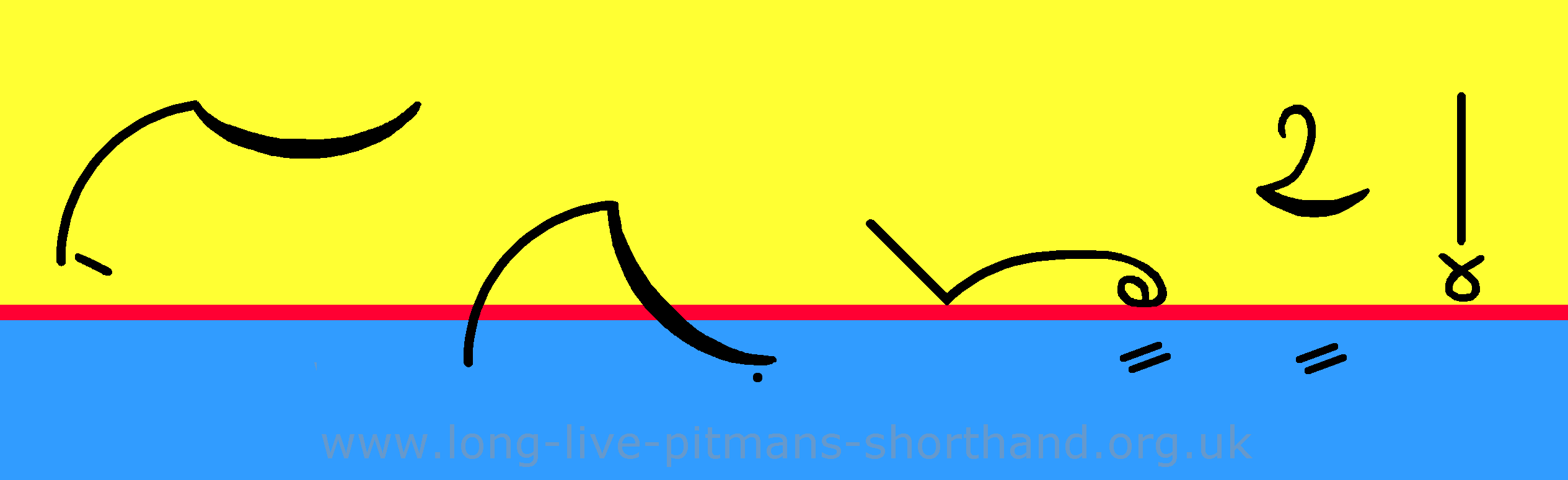
59. The Queen's house was commissioned in 1614
by Queen Anne, wife of King James I of England, and was completed in 1635 by
Henrietta Maria, Queen to Charles I. The house originally straddled a road,
joined by a first floor bridge, which was subsequently built over to produce the
present square building. The colonnaded section in the centre of the rear of the
building would have given a
grandstand view of the games, hunts and spectacles in the
park that were the royal entertainment of choice in those days. The house and
its adjacent buildings are now part of the National Maritime Museum. On display
inside is a model in a class case showing
this
building at the beginning of its life and the Palace of Placentia on the riverfront.
(132 words)


60. Entry is free daily and you go in by the door between the grand
steps at the front of the building. For security reasons, any large bags must be
left in the safe-keeping of the attendants at the welcome desk, who store them in
a room behind that only they have access to, in return for a numbered tag. In the centre of the house is a large
room with a marble floor in a
black and white diamond pattern within squares and circles. If this was ever used for
dancing, I suspect the bold patterning would have caused a few giddy turns for
any dancers glancing at the floor too often, especially as the evening wore on.
Although the floor is striking, its plain colours would have shown up the rich
costumes of the royal guests to great effect. The stone steps of the Tulip Staircase
lead up to the gallery,
from where you can get a birds-eye view of the patterns on the marble floor.
Leading off the gallery are the upper rooms with their displays of paintings. The staircase
is topped by a cupola which lets in the light, hence the blue tinge. I wonder
how many people go up the staircase and never actually look towards the ceiling,
and so miss this fascinating and beautiful sight.
(220 words)

61. All the rooms are used as galleries for historical paintings.
Lighting is kept very low, with the minimum of illumination for each painting.
The paintings of Henry VII and Henry VIII are quite small. The next painting is
Elizabeth I in all her royal regalia, dripping with jewels and pearls, gold
embroidery and the finest lace. Most of the portraits are of royalty and
dignitaries, but the majority of the paintings on display are of a seafaring
nature, showing ships, battles and voyages. There are also a few 20th century
ones depicting the Second World War. Some of the scenes remind me of accounts
told by relatives who lived through that war and so those paintings are somewhat
"closer to home". It is a reminder that the people in the very old pictures also
represent real sailors and their families, with their own stories of loss and
heartache in the aftermath of the battles or disasters at sea. (161 words)

Elizabeth's jewelled dress and lace, and Henry VII's
ermine robe

62. All the paintings are originals and you can get as close as you
wish to inspect how the paint effects were achieved. Every brush stroke can be seen in
minutest detail, as shown in these close-ups of Elizabeth's sumptuous dress.
The portrait would not have been painted from life, but from an approved image,
showing her perfect and ageless. One might think that once the artist had found
a method for representing, say, pearls, he would then only have to repeat it all
over. But close inspection reveals that the items have been painted with the
nuances and variations of lighting that would occur in real life. Capturing
these subtle effects is what gives a painting life and brings it a step closer
to the reality that it attempts to portray, and sets apart the skilled artist from
one who produces meticulous but flat and lifeless works.
One cannot help wondering about the conditions in which the
artworks were created, the life of the artist and how long each painting took to
complete. Many would have been produced by students or apprentices, with the
finishing details being done by the master himself. But most of all one is in awe of
their acute eyesight to paint such tiny details, all the more astounding as they
only had limited daylight and candles, and not the vast array of daylight-corrected
lamps and adjustable lighting fixtures that we enjoy nowadays.
(237 words)
-
nuances: outline shows anglicised pronunciation "new-ance", for "noo-ance"
you would use a diphone

-
fixtures: in the singular "fixture" the U diphthong is struck
through the end of the Tee


63. This portrait of Inigo Jones, the architect of the Queen's
House, was painted by William Hogarth a century after Jones lived, based on an
engraving, which was itself based on an earlier drawing by van Dyck. Inigo Jones
was also greatly involved in stage design, costumes and sets for the theatre,
and was thought to be the first to introduce movable scenery.
The second
portrait is Captain James Cook, the explorer and cartographer of the Pacific
Ocean, painted by William Hodges. Cook took with him chronometer K1, which was a
copy made by Larcum Kendall of John Harrison's H4 version, on his second and
third voyages. He was very satisfied with its performance and after the second
voyage he described the watch as "our faithful guide through all the
vicissitudes of climates."
David Samwell accompanied James Cook as surgeon on
board the ship Resolution, and described him: "He was a modest man, and rather
bashful; of an agreeable lively conversation, sensible and intelligent. In
temper he was somewhat hasty, but of a disposition the most friendly, benevolent
and humane. His person was above six feet high: and, though a good looking man,
he was plain both in dress and appearance. His face was full of expression: his
nose extremely well shaped: his eyes, which were small and of a brown cast, were
quick and piercing; his eyebrows prominent, which gave his countenance
altogether an air of austerity." (237 words)
-
Pacific Ocean: you could also use Shun Hook for "ocean", see
also "Atlantic Ocean" in the placenames list on
Contractions Optional
page. The shape of the outline would then be the same as
"pacification"
-
vicissitudes: other derivatives =

Pacific Ocean, vicissitude vicissitudinous
-
Samwell: compare the outline with "Samuel"
-
on
board the: "board" on its own has full strokes
-
humane: see
Distinguishing Outlines List 2 human/humane
-
eyebrows: the singular has the final diphthong joined to the
stroke

Samuel board
eyebrow

64. As all the rooms in the house are used to display paintings, one
does not get any sense of what they were originally used for. This is the only
one with a decorated ceiling and was the royal bedroom. What would you think if,
several hundred years from now, you could come back and see people trailing
through your house and bedroom, looking at paintings! To preserve all the artwork the
lighting level is minimal and one might guess that it would have been even less
in its day, with the only illumination being by a multitude of candles. The
gilded parts in such decorations were designed not only for richness and
opulence, but also to catch the candle-light. As one walked around, different
parts would light up, giving the scenes depth and an impression of movement. This is
entirely different from our own modern habit of flooding rooms with light and seeing
everything laid out for inspection simultaneously. Nowadays we satisfy our
desire for movement and narration of stories through films, but I believe
this
is the effect that these sceneries would have had at the time, with movement
coming from the observer's eye being directed by whichever part
caught the light, and never seeing all of it at once.
(211 words)


65. Filling the end wall of Room 24 on the ground floor is an
enormous painting by J M W Turner of the Battle of Trafalgar. A low glass
barrier keeps visitors at a little distance. This beautiful boat-shaped glass sculpture by Rosie Leventon in
the same room provides a stark contrast to the tumultuous scenes in Turner's
painting and the gloomy scenes of ships in storms at sea. It is so calm
and elegant, it must surely win over even those who do not normally appreciate
modern art. The photo below is part of a more upbeat painting – Thomas Danby's
"A new bride for the sea" – showing construction of a ship on a fine day, with
both carpentry and sea gleaming in the warm sunlight. The caption describes the
painting as "an idyllic vision of rural labour in Victorian Britain". It seems
unlikely that the lives of the workers lived up to such a portrayal, the
idyllic and free life being experienced only by the seagulls wheeling in the sky above them.
(172 words)


66. The original building on this riverside site
was the Palace of Placentia, also known as Greenwich Palace. This
was demolished in 1694, having fallen into disrepair, and the Seamen's
Hospital was built from the King Charles Wing of that palace. The
buildings were designed by Sir Christopher Wren and Nicholas Hawksmoor,
and completed by Sir John Vanbrugh following Wren's plans. They were laid out with a central gap so that the view from the Queen's
House was not impinged upon, and this has resulted in a marvellous
uninterrupted view from the riverside to the top of the hill. The
Hospital was intended to house 1,500 pensioner seamen in four main
buildings
– King Charles Court, Queen Mary Court, Queen Anne Court
and King William Court. From 1883 to 1998 the buildings housed the
Royal Naval College and since then it has been administered by the
Greenwich Foundation, with leases granted to the University of
Greenwich and Trinity College of Music.
(159 words)


67. These globes on the gate plinths are smothered in meridians
and lines of latitude going in all directions, quite giddying to
contemplate, especially if the clouds are also scudding past, giving
the false impression of the balls being about to topple. No doubt each
line is positioned meaningfully, but to the uninformed visitor they resemble firstly a ball of string, which one hopes
does
not
roll away, and secondly a giant chocolate orange (white chocolate of
course) which we definitely would like to see roll away, so that we
can all help to eat the pieces of the chocolate sections
– with
permission from the Chairman of the Greenwich Foundation, of course!
Hands up all those willing to volunteer to help eat all the
delicious fragments!
(125 words)


68. This regal-looking creature on the Naval College
gate emblem is not a lionfish, and definitely not a sea lion, but we
can be sure that he is not only king of his realm, but master of the
seas as well. The second gate is directly behind the camera in the
photo of the Naval College buildings, and both emblems seem to be
surrounded by a circle of officer's gold braid. Many of the statues, crests and emblems of the past are
allegorical in nature, embodying abstract principles in human or
animal form, conveying the information without written words.
Centuries later we need to unravel the meanings of some of the symbols
but they clearly advertise the status of the occupants. The method
is still with us today in our company logos, shop signs, notices on
doorways, stairs and exits, and in our road signs, whose messages
need to be instantly recognisable and easy to remember.
(155 words)
-
sea lion: the vowel in "sea" would normally stay with the Ess but there is no room for it in
the angle
-
in
our: Hook R is used for "our"
-
exits: see Distinguishing Outlines List 2 exits/gates


69. This is the Painted Chapel in the centre of
the Naval College buildings. The decoration is
dense, but not too busy as it is the same pattern repeated all over.
The gilding and pink walls give the interior a warm glow. At the
entrance to the chapel is a marble bust of Vice Admiral Sir Thomas
Hardy, with the inscription: "Eminent for judgement and self-possession; ever anxious for the improvement of the service, to
which he had devoted himself; equal to all its difficulties and
duties, and conversant with its minutest details, the name of this
gallant and distinguished officer will descend to posterity, as one
of the noblest ornaments of the profession, to which England is so
much indebted for security and renown."
Being equal to the difficulties of one's chosen
profession and conversant with its minutest details does sound like
the path to excellence and success in any endeavour, for anyone,
anywhere, at any time, not just those who find themselves in the public eye and
historical figures. Cold and colourless marble effigies have an
inhuman quality, and I prefer to show here his portrait on the
public house inn-sign in Greenwich, which puts a more human
face on a famous name that many people only remember from their
history lessons at school. The original painting is in the National
Maritime Museum's collection.
(225 words)


70. The Painted Hall is located across the square from the chapel,
and was intended to be the dining
area
for the pensioner seamen living at the Hospital, but it was considered too
magnificent for this purpose and became instead an attraction for tourists. From
1824 to 1936 it housed a gallery of Naval Art. The Hall is approached by a flight of grey marble steps and the floor throughout is black,
white and grey marble.
Several wheeled mirror trolleys are placed along its length so that visitors can
admire the ceilings in comfort, and these do appear to be magnifying, so the
details are easily made out.
At the rear of the hall is a plaque commemorating those Americans
who volunteers to serve as sea officers in the Royal Navy in the Second World
War "when the fate of Great Britain and the cause of freedom hung in the
balance."
The paintings are allegorical scenes showing the
Protestant succession of English monarchs and were painted in the Italian
baroque style by Sir James Thornhill
over a period of 19 years. The Hall is freely open to tourists and can also be hired for private functions and
filming, a truly dazzling setting for any occasion and a dream location for both
bride and photographer.
(213 words)

I have my own theory to explain the tumultuous
sceneries on all the ceilings and walls – someone has finally found the
television aerial, but everyone is still searching for the cable and the socket,
before their favourite programme starts! This is actually the painting, I
have not edited it.

71. Here is James Thornhill, who painted the
murals, thanking visitors for their donations to the conservation of
his work. The cutout figure has been skilfully painted by a modern
artist, copying the self-portrait that appears on the right
hand side of the very end wall, and creatively providing the back of
his coat and his other leg. Thornhill was father-in-law to the painter
William Hogarth.
(65 words)


72. The town centre at Greenwich is quite small,
in comparison with the park and historical buildings on their
extensive sites. There are a lot of small shops crowded in. The
heavy through traffic means that this is not a place for the tourist
to stroll in peace and quiet, but there are plenty of places to buy
souvenirs and refreshments. The tavern and the fish and chip shop
make one think back to the early days of Greenwich, when the town
first came into existence. Greenwich was a small fishing village and
the services of these establishments – ale and fish – would have
been provided in one form or another throughout its history. Chips
of course are a relatively recent introduction, with the potato
being brought back to Europe by the Spanish from South America in
the late 16th century.
(139 words)


73. St Alfege Church is to the west of the town centre. St Alfege
was the Archbishop of Canterbury. Viking raids had become a regular scourge and
in 1012 Danish Vikings moored at Greenwich and stayed for three years. They
raided the area without mercy and sacked the town of Canterbury. They took
Alfege hostage and imprisoned him at Greenwich. The townsfolk could not pay the
ransom, and Alfege would not permit any ransom to be paid for his release, and
so the Danes eventually killed him. The first church was reputedly built on
the location of his murder. The church was rebuilt in 1290, and in 1710 it
collapsed during a storm, as the structure had been undermined and weakened by
excavations for burials. The present-day building is the third church and was
designed by Nicholas Hawksmoor.
Alfege also gave his name to St Alfege's Hospital
at the bottom of Vanbrugh Hill, although the buildings started off as a
workhouse and infirmary for paupers and the sick. It was demolished and rebuilt
as Greenwich District Hospital between 1969 and 1972. This closed in 2001 and
was demolished in 2006, with plans for residential re-development.
(194 words)
Greenwich:
Part 1
- Part 2
- Part 3
- Part 4
- Part 5 -
Part 6
Top of page |