|
Cutty Sark, Foot Tunnel, North
Thames views, Thames Clippers,
River, Dragon on Prince Frederick's Barge
More photos of Cutty Sark restoration progress on my
other website:
www.lucypaintbox.org.uk/Photo-gallery-places-Greenwich-Cutty-Sark.htm


Stitched pictures, hence the wavy blue barrier,
looking like a gently undulating sea!

74. This is the state of the clipper Cutty Sark in August 2011,
undergoing extensive repairs and refurbishment, after the fire in
May 2007. The ship was already scheduled for conservation repairs
and had been partially dismantled at that time. Having lived in the
area for many years and passing the ship every morning on the bus to
school, I found it disconcerting not to see the masts filling the
sky, but instead several very large cranes. However, it is
heartening to see the stern looking quite magnificent in black and
gold, a taste of the glories to come. The fence round the site shows
pictures of the progress, as well as the ship in full sail and a mock-up of how the finished site will look. The ship will be held
aloft on a steel girdle and you will be able to walk underneath the
hull. The glass enclosure meets the ship at water level. I would
suppose that on a blue sky day the glass will look like rolling sea
surrounding the ship, but on a grey day it might resemble the skirts
of a hovercraft! Many people will know the ship from past televised
scenes of the London Marathon, as the runners circle round the ship
– the professional runners just getting into their stride, and the fun runners still
managing to smile and wave, even though they are beginning to
realise just what they have let themselves in for.
(241 words)
-
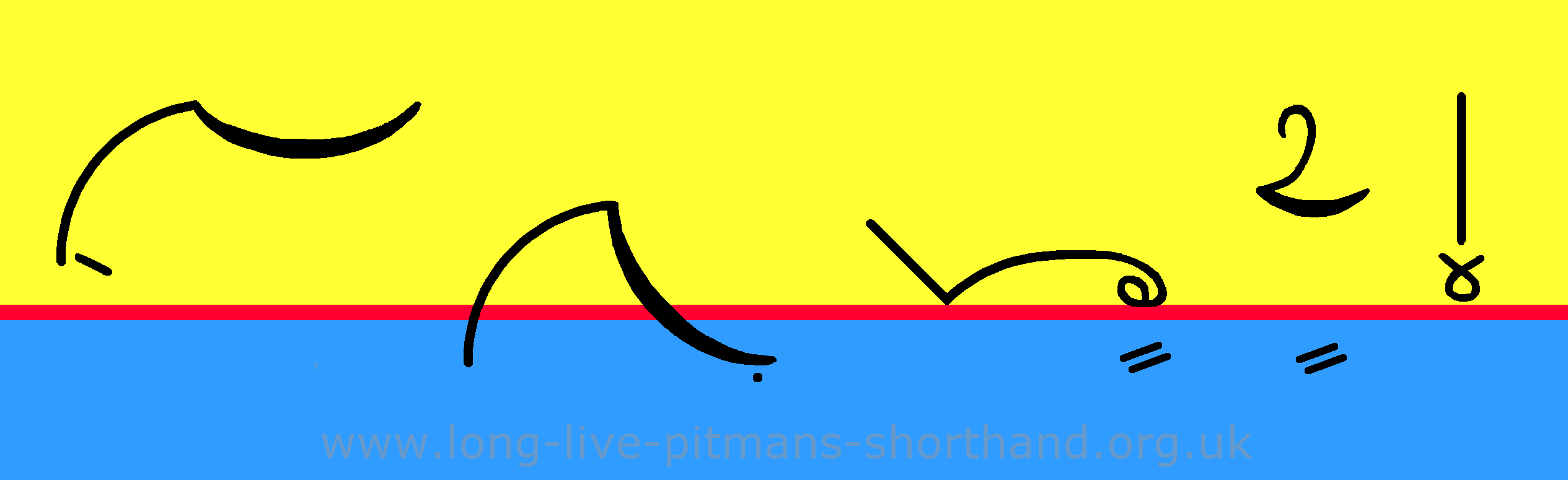
undergoing: not using the short form "go" therefore has the full
diphone rather than just a dot on the Ing
-
refurbishment: using halved En for "-ment", keep the En light and short, so that it does not
look like "refurbishing"
Picture taken June 2006

75. The Cutty Sark was built for Scotsman John
"Jock" Willis. She is a sailing clipper
built for high speed in order to outrun rival ship Thermopylae in
the China tea run, and later the wool run from Australia. She
travelled all over the world until 1923, when she was bought by
Wilfred Dowman who brought her back to the UK and restored her. Her
last sea voyage was in 1938 and her last time in the water was in
1954 when she was towed into dry dock at Greenwich.
The ship was named after a character in Robert
Burns' poem "Tam O'Shanter". A girl called Nannie Dee wearing a
short-cut shirt or undergarment, known in the Scots dialect as a
cutty sark, was angrily pursuing Tam at high speed for having gazed
at her dancing with the witches. Tam escaped by crossing a river on
his horse Maggie or Meg,
but at the last moment the horse lost its
tail, grabbed by Nannie who was unable to cross the water.
(170 words)
-
in
ord(er to): contracted phrase
-
all
over (the) world: contracted phrase
-
last time: phrase omits the T of "last"
-
Maggie Meg: names should be vocalised whenever possible

Pictures taken June 2006

76. The ship's figurehead Nannie spent the next
80 plus years crossing all the water in the world, chasing the rival
ship instead of a horse. Not only is her own cutty sark flowing behind her, but also the ship of the same name in tow,
looking like an extension of her skirts. The ship's Scottish name
ensured that the nationality of her owner and the builders went with
her everywhere. Maybe Jock Willis also thought that Nannie's dislike
of water made sure that the ship stayed on top of it, and not below,
and that Nannie would provide maximum speed to get back to land!
From the side view she looks young and beautiful but her face is
actually frowning and snarling in anger. Whenever in port the crew
would place in her hand a horse's tail made of old rope. Considering
that the horse in the poem was marginally faster than Nannie, maybe
it should have been considered for the job of figurehead, but it
would not have inspired the same interest, loyalty and cautious
superstition from the crew. Most of all she embodies a
teeth-gritting determination to outrun her
competitor.
(192 words)
-
in
(the) world: contracted phrase
-
cautious: ensure the Kay is straight, so the outline doesn't
look like "anxious"

Thoughtful
holes in the barriers for visitors to aim cameras through - full
sail painting - final appearance mock-up

77. The design of tea clippers was based on the
American Baltimore cotton clipper ships. The name comes from one of the
meanings of "clip" which is to move swiftly. Their grace and
elegance is aptly described by George Campbell in his book China Tea
Clippers – "The delightful form of the hull of a tea clipper
... all
being moulded perfectly into the curves toward the keel, must surely
rank as the most aesthetically perfect manmade shape."
The Cutty Sark's specification for building and
fitting out lists not only the construction requirements and
materials in precise detail but also an inventory of every item
needed on board, from guns to teaspoons, anchors, foghorn, deck
scrubbing brushes, fishing lines and shark hook, teak hen coops and
pig houses, copper tea kettle and coffee pot, complete tea service
and fancy bread baskets – just a few of the hundreds of items
listed. Reading the inventory is almost like a trip through an
average day on the ship, although many of the nautical equipment
terms would only be intelligible to those with sailing experience.
Also required was "a figurehead by Allan with suitable carving about
the stern* and to correspond with the
name of the ship" and "the whole to be of the very best workmanship,
material and finish." (213 words)
*stern = rear; stem (or bow) = front.
As the figurehead is at the front, the carving referred must be the
ornate decoration at the rear (photo at top of page)
-
swiftly: has downward Ell to preserve similar motion of the
strokes - both going anticlockwise
-
aptly: safer with first vowel inserted, see
Distinguishing
Outlines List 1 aptness/badness/pettiness
-
hull & whole: both need clear vowels, as they are interchangeable in this passage
-
requirements: Ray intersected
-
foghorn: "horn" on its own has Tick Hay
www.johnsankey.ca/willis.html
Complete specification
for building and fitting out the Cutty Sark
www.tea.co.uk/tea-clippers
Brief history of the tea clipper races
www.stephenweir.co.uk/stained-Glass-Glasgow.html
Cutty Sark in stained glass,
example of a commissioned window
"The Crews of the Cutty Sark" by S F
Bailey, 1989, published by the Cutty Sark Society, lists all the
names and details of crew members.
(Paragraph numbers 78 & 79 reserved for Cutty Sark update in 2012
when restoration is complete)

Looking towards the centre, sloping down. The short length of
narrower reinforced walls.

80. In the background
of the Cutty Sark photo is the glazed dome over the lift and
stairwell down to the foot tunnel under the river, which links Cutty
Sark Gardens to Island Gardens in Tower Hamlets on the north side.
The tunnel is
370 metres long, 2.7 metres in diameter and just over 15 metres
deep. Its width does not sound much but it is not a cramped area. It was
opened in 1902 to replace the ferry service, so that workers could
travel more easily and cheaply from their homes in South London to
the shipyards and docks on the Isle of Dogs. At the north end
is a very short length reinforced in steel and concrete, as that
part was damaged in World War II.
The original lift was
a large room with wide doors on both sides and an attendant to
operate it. It had seats on each side and the sort of varnished
wooden panelling that you might see on a vintage train carriage. A
guess at its capacity would be about 50 people. Passengers entered
at one side and exited at the other and this
arrangement enabled it to serve the large numbers of people using it
to travel to work.
(206 words)

Dog on lead, thankfully. Just
past the centre, path sloping upwards with the end out of sight.

81. The tunnel
is identical to the one at Woolwich. Some time in the 1920's my
grandfather, on his way to work in North Woolwich, saw a dog running
up and down the tunnel. The dog was still doing the same
when he returned home that night, never going far enough in either
direction to reach the stairs. The tunnels slope down to the middle
and the ends cannot be seen during the walk. My grandfather rescued
the anonymous dog and took it home with him. In later years, he
delighted to tell his children of the dog's great intelligence.
After a theatrical pause, and seeing that all eyes were intently
fixed on him, he boldly told them of the astounding exploit – he
said he came down one morning and found the dog in the kitchen
frying himself a breakfast of eggs and bacon. There would have been
an explosion of incredulous laughter from the children and an
equally resounding guffaw from himself at such an outrageous
proposition. The moral of the story was: don't hang on to someone's
every word, because they may be tempted to lead you "up the garden
path". The other lesson from this is the necessity to press on, and
not give up and turn back, a useful maxim for any endeavour.
(216 words)

Island Gardens café – no words
needed!

82. After your surreal journey along the tunnel, you
emerge into Island Gardens where you can sit facing the river and
enjoy the real world and fresh air. Looking at the waves reminds you
of what was above your head on your subterranean walk, a fact which
suddenly becomes even more pressing, as you will be doing it all
again in reverse quite soon. There are river walks in both
directions, which are more gritty than pretty, and a blue sky day would
help if you prefer your photos to look more inviting and spacious.
If you position yourself directly opposite the Old Royal Naval
College, you can compare your own photo with the painting of this
scene by Antonio Canaletto "Greenwich Hospital from the North Bank
of the Thames".
(129 words)

http://www.portcities.org.uk/london/server/show/conMediaFile.1272/Greenwich-Hospital-from-the-North-Bank-of-the-Thames-by-Canaletto.html
www.portcities.org.uk PortCities UK website is run by the National
Maritime Museum (links only permitted to their home page, so clipboard the
full URL above)


83. I name this ship Spotted Dick! This is a Thames Clipper
catamaran, real name Hurricane Clipper, painted in holiday mood colours and
brightening up a grey day and the murky, cold, uninviting waters of the Thames.
They really do zip past and you have to be quick with the camera. The crane is
on the shore, not on the ship! A spotted dick or spotted dog is the name of an
English steamed suet pudding, the spots being the currants. It is a favourite of
school children and, with plenty of sweet custard, is ideal for warming one up,
ready for a breezy day's outing to Greenwich or along the Thames.
This vessel is named after something that anticipates and
describes its great speed and power, exactly the same reason as the naming of
the Cutty Sark – an act of faith, confidence and expectation before the ship
ever hit the water on its first launch. Even when stationary, the name lets
prospective customers take a good guess at its purpose. However, I doubt if a
sea-going ship named after a storm (as several of these clippers are) would
inspire the confidence of its sailors, unless they and the ship's owner were of
a defiant disposition.
(205 words)
-
breezy: ensure the R Hook is clear, as "busy" would also make
sense
-
expectation: you could use the
optional contraction expec(tation)
-
sea-going: not using the short form "go" therefore has the full
diphone rather than just a dot on the Ing


84. We are now back on the south side of the
Thames, in front of the Old Royal Naval College buildings, looking eastwards
down river. At low tide there is both sand and shingle. Wide stone steps lead
down at intervals and as you walk along the shore, your eyes are focussed on the
stones, to see if anything of interest has washed up. Fragments of dressed stone
and wave-worn rounded red brick lie scattered amongst the pebbles, conjuring
images of Elizabethan or Tudor houses, or Roman buildings of long ago. There is
surprisingly little modern rubbish compared to the piles of refuse that often
accumulate in sheltered corners of seaside beaches. Although the river in the
photo appears clean and blue, it is actually a thick mid-grey from the silt that
the river carries, and is not at all inviting, or even hygienic, for paddling.
The green on the embankment wall indicates the level at high tide.
(157 words)

85. Here is another of the
twelve Thames Clipper high speed catamarans that ferry tourists and commuters
along the Thames, from the London Eye down to Woolwich. This seems to be our
modern-day version of the Cutty Sark, boats built for speed in order to
capture
trade, with a quick turnaround of "cargo", but offering vastly more comfortable
accommodation and calmer waters to travel on.
After watching the boat speed past, and another
passing in the opposite direction, I resumed my inspection of the foreshore for
interesting debris and photo opportunities. A sudden roaring and growling of the
water took me by surprise, as a succession of large wakes from the two clippers
arrived at the shoreline, having made their way in my direction, completely silently,
unseen and unnoticed. The grey soupy water rose up and pounded itself into white
foam on the pebbles. The waves could have knocked over any small child standing
at the water's edge and it was a stern reminder that the foreshore is not a
playground. I did not find anything remotely interesting, no Roman coins or
ancient pottery came into view. I returned up the stone steps,
staying away from
the slippery green edges and going gingerly up the middle where the sun had
baked the stone dry. I was rather glad to be looking down on the river and not
level with it. I don't think any of my doughty Greenwich ancestors would have
recognised much of the seafaring spirit in me that day!
(250 words)


86. This view is looking
upriver towards Deptford and eventually Central London. Greenwich Pier is on the
left. The Cutty Sark ship is located behind the pier, wistfully watching the
clipper catamarans going past and remembering her trips to China and Australia.
She is well pleased with her refurbishment and looks forward to regaling
visitors and schoolchildren with tales of her 80 years of adventures around the
world.
Deptford is named from the deep ford over the
River Ravensbourne, which was on the route of the Celtic trackway that later
became known as the Roman road Watling Street. The "P" in Deptford is not
pronounced. It started as a fishing village and became a centre for
shipbuilding. At one time it was called West Greenwich, with the Greenwich of
today known as East Greenwich, but this usage ceased in the 19th century. Queen
Elizabeth I knighted Sir Francis Drake here.
My own memory of Deptford is that it appeared to
my young eyes to be merely a shabby extension of glorious historical Greenwich,
and I felt I was stepping into an old postcard of grimy 19th century
backstreets. I could just about see over the wall and look down on the Quaggy, a
muddy little river discharging into the Ravensbourne. I was fascinated by its
name, which is an adjective meaning soft or flabby, as in quagmire. The Quaggy's
silt will eventually find its way to the mudbanks at Erith where the river
widens and the mud is deep and treacherous-looking, with low tide exposing
gullies deeper than a person.
(260 words)
-
refurbishment:
halved En used for "-ment", keep the En light and short, so that it does not
look like "refurbishing"
-
Celtic: can also be pronounced "seltic" which is
sometimes used
for modern items e.g. football teams. Archaeology generally uses
"keltic" and it is occasionally spelled with a K
-
quagmire: "kwog-" is correct but it can also be pronounced "kwag-"

I hope you enjoyed your tour of Greenwich, and
I will leave the last word to this hypnotic-looking golden dragon/sea serpent on the prow
of Prince Frederick's state barge in the National Maritime Museum –
"May
your shorthand pen glide over the paper as smoothly and swiftly as I did up and down the
Thames.
Say after
me: I will practise my short forms, I will practise my short forms, every day,
every day ..... !"
Greenwich:
Part 1 -
Part 2 -
Part 3 -
Part 4 -
Part 5 -
Part 6
Top of page |