Long Live Pitman's Shorthand banner text

Completely devoted to New Era Shorthand


Shorthand Reading Photo Tour – Greenwich Part 2

Long Live Pitman's Shorthand! Free resources
 

Search this website.
Results by
Freefind
Advanced

Or use my Search Page - 1000's of outlines on this site

Home   

Recent Additions

About

Shorthand Everywhere

Why Learn?

Notes for Beginners

Pen and Paper

Pen & Pencil Reviews

Dictation

History

Downloads

Links

Guestmap & Guestbook links page

Theory
 
Intro
 1   Strokes
 2   Vowels
 3   Forming Outlines
 4   Circles
 5   Loops
 6   Hooks Intro
 7   Hooks R L
 8   Hooks N F V
 9   Shun Hook
10  Halving
11  Doubling
12  Hay Aspirate
13  W Forms
14  L Forms
15  R Forms
16  Imp/Imb
17  Ish
18  Prefixes
19  Suffixes General
20  Suffixes Contracted


Short Forms
Intro
SF List 1
SF List 2
SF List 3
SF List 4

Contractions
Contractions Intro
Contractions Main

Contractions Optional

Phrasing (in progress)
1 Intro
& Contents list
2 Theory
3 Theory
4 Omission
Part words
5 Omission
Whole words
6 Miscellaneous
7 Miscellaneous
8 Intersections

Numbers

Distinguishing Outlines
DO Intro
DO List 1 A-C
DO List 2 D-H
DO List 3 I-P
DO List 4 Q-Y

Vocabulary
Intro
Punctuation
Shorthand Dictionaries

Word Lists
Text Lists from PDFs

Glossary

Yellow Teddy

Pitman's New Era Shorthand Reading Pages

Reading Intro + List
About Shorthand
Shorthand Speed
Calendar Quotes
Bible
Christmas Carols
Faith 1: Christmas Story

Kent Places
Miscellaneous 1

READING PHOTO TOURS:
Garden

Hastings, East Sussex
Greenwich Part1
Greenwich Part2
Greenwich Part3
Greenwich Part4
Greenwich Part5
Greenwich Part6


Pavilion Tea House, Royal Greenwich Observatory, Meridian Line, Shepherd Gate Clock, Standard Measurements

Greenwich Park - Pavilion Tea House Greenwich Park - Pavilion Tea House - weathervane of Admiral Lord Nelson

Pitman's New Era Shorthand Reading: Greenwich para 14

14. Opposite the South Building is the octagonal Pavilion Tea House, dating from 1906 and designed by Sir Henry Tanner. On its roof is a dovecot, and above that a weather vane showing Admiral Lord Nelson surveying the scene through his telescope. The ground floor part was built as an open veranda but in 1967 it was enclosed and more recently the interior has been opened up to improve the use of space. It is surrounded by a hedged garden where visitors can enjoy their refreshments at tables under large parasols, providing a safe area for those with children, as well as some peace and space away from the crowds of tourists in and around the Observatory buildings. The tea house is open all year round and toilet facilities are available nearby behind the South Building, accessible from The Avenue. (139 words)

 Greenwich Park - Royal Greenwich Observatory - Flamsteed House & Meridian Courtyard

Pitman's New Era Shorthand Reading: Greenwich para 15

15. In 1675 King Charles II commissioned the building of the Royal Observatory on the promontory in Greenwich Park known as Castle Hill. John Flamsteed was appointed the first Astronomer Royal, whose duties were to "apply himself with the most exact care and diligence to the rectifying of the tables of the motions of the heavens, and the places of the fixed stars, so as to find out the so much desired longitude of places for the perfecting of the art of navigation." The octagonal building is named Flamsteed House and was built on the foundations of the previous structure, Greenwich Castle, and so is not exactly aligned with the meridian. The scientific work of the Royal Greenwich Observatory moved to Herstmonceux Castle in Sussex over the period 1947 to 1957 due to light pollution in London, where it remained until 1990. The buildings at Greenwich are now administered by the National Maritime Museum. The entry charge covers the Meridian Building, Flamsteed House and the Meridian Courtyard. (167 words)

Greenwich Park - Royal Greenwich Observatory - Meridian Building chronometers Greenwich Park - Modern copy of John Harrison's first marine chronometer

Pitman's New Era Shorthand Reading: Greenwich para 16

16. In the rear of the Meridian Building there is an extensive collection of portable chronometers on display, with the conservation laboratory in full view behind, which will warm the heart of anyone with this special interest, and is free to enter. The measurement of longitude was essential for accurate navigation and this seemingly impossible problem was eventually solved by the ingenuity of John Harrison, a Yorkshire carpenter and clock-maker. He spent 50 years inventing and working on a succession of accurate and reliable portable chronometers that could be taken on sea voyages. This enabled the ship's captain to compare local time with the chronometer which would remain set at a standard time, such as that at Greenwich. In this way he could compute the distance travelled and, in conjunction with his other measurements, find the exact position of his ship.

John Harrison eventually received a total of £23,000 (more than two million pounds in today's values) for his contributions to solving the longitude problem, although the actual prize money itself was never paid out. Other smaller amounts were granted to other inventors for their contributions. Four of Harrison's timepieces are on display in the main museum, three of them in full working order, along with other historical astronomical and scientific equipment. To see these you will have to enter the chargeable part of the museum, but you can see, at no cost, a replica of Harrison's first timekeeper, made by Leonard Salzer of Biggin Hill between 1970 and 1976, on display in the National Maritime Museum building at the bottom of the hill. (263 words)

  • captain: you could use the optional contraction capt(ain)

  • prize: outline is same as "price" so context is needed to ascertain which is meant

Greenwich Park - Snowman of Sir Isaac Newton outside Flamsteed House

Pitman's New Era Shorthand Reading: Greenwich para 17

17. Some time in the 1980's Sir Isaac Newton appeared at the Observatory in the form of this snowman built in the Meridian Courtyard of Flamsteed House. Unfortunately he seems to have his back to the view of the Thames and London, but he is in just the right place to welcome visitors. On the same day the grassy slope beyond was transformed into a magnificent icy downhill ride, full of parents and children rolling and sliding down on anything they could find to sit on, including one person trying out his skis. This was all rather reminiscent of the historical accounts of the game of tumbling which was a popular entertainment for visitors to Greenwich Fair in past centuries, and may account for Snowman Newton's amused grin! His name appears amongst the other scientists on the South Building, over the terracotta figure of Astronomia. (144 words)

Greenwich Park - Flamsteed House and time ball Greenwich Park - time ball on Flamsteed House

Pitman's New Era Shorthand Reading: Greenwich para 18

18. The time ball on top of Flamsteed House was installed by the Astronomer Royal John Pond. The explanatory plaque on the gate reads: "The red Time Ball on top of Flamsteed House is one of the world's first visual time signals. It was installed in 1833 (though the present one dates to 1919) to enable navigators on ships in the Thames to check their marine chronometers. The Time Ball drops daily at 1300 hours (GMT in winter, BST in summer). It is raised halfway up the mast at 1255 hours as a preparatory signal and to the top 2 minutes before it drops." The time is counted when the ball starts its descent, not when it reaches the bottom. The ball's descent is actually a stately lowering rather than a rapid drop. It would also have been of service to everyone within sight of it who owned a timepiece, and especially clock and watch makers, who could then provide the correct time to their customers. (165 words)

Greenwich Park - Meridian House Greenwich Park - Meridian House - Prime Meridian plaque

Pitman's New Era Shorthand Reading: Greenwich para 19

19. The red line above the door on the Meridian Building in the courtyard marks the Prime Meridian. The line is also marked in a double steel strip in the granite surface on the right of the photo, which was taken from the east side at the gates. The meridian line designates zero degrees longitude and marks the boundary between the east and west hemispheres of the earth. The International Meridian Conference held in Washington DC in the United States of America in 1884 chose Greenwich as the location of the Prime Meridian. Greenwich won the vote because it was already being used as such by two-thirds of shipping and it was felt that a change from the established usage would not be beneficial. (123 words)

Greenwich Park - Meridian Courtyard - millennium sculpture

Pitman's New Era Shorthand Reading: Greenwich para 20

20. The steel line continues across the courtyard, with this sculpture placed on it as a visual description of the line. This photo of the sculpture was taken on the west side, within the courtyard. When the place is thronging with visitors, it can be difficult to get a clear photo of the buildings as a whole. Cold or dull weather would seem to be the most likely option to avoid the crowds, as hopefully the tourists would be warming themselves in the museums and coffee shops. Early in the morning might also prove fruitful for your photographic endeavours. At peak visitor times consideration for others taking photos can result in a halting and zigzag progress from one point to another! (120 words)

Greenwich Park - Meridian Courtyard - Meridian line

Greenwich Park - gate below Meridian Courtyard Greenwich Park - path below Meridian Courtyard Greenwich Park - The Avenue - Meridian line marked in granite

 Pitman's New Era Shorthand Reading: Greenwich para 21

21. Standing astride the Meridian Line seems to be the favourite place for tourists to have their photos taken. An orderly queue is formed and everyone takes their turn to stand on the line with a friend taking the picture. Most of them seem to prefer to have the sculpture and scenery in the background. There is a charge to enter the courtyard and museums, but reasonable pictures can be taken from outside or through the railings.

If the courtyard is too crowded or too expensive for your liking, there are two free places nearby where you can have your photo taken astride a marked Meridian Line. Firstly, just below the courtyard through the gate on the path that leads down behind the buildings, where the line is marked in brass on the wall and ground. Secondly on The Avenue, immediately behind the South Building, just a little way past the public toilets, where the line is marked by a row of granite setts in both pathways and in the road.

At night the meridian line laser is beamed northwards from the Meridian Building and is visible for many miles. The park closes at dusk so the easiest way to see it during the day is via the illustration on the park notice boards. (213 words)

Greenwich Park - noticeboard showing Meridian laser

www.panoramio.com/photo/49359728 Panoramio user's excellent view of this laser in the snow at dusk

www.nmm.ac.uk/visit/scenic-attractions/meridian-line/standing-on-the-meridian-line-360-panorama
A controllable 360 degree still panorama of the Meridian Courtyard

www.waymarking.com/cat/details.aspx?f=1&guid=a088c7d0-af6d-425d-a673-9b6cc93d4640
More Meridian Line markers throughout the UK

www.thegreenwichmeridian.org

Greenwich Park - Royal Observatory Shepherd Gate Clock and standard measurements Greenwich Park - Royal Observatory Shepherd Gate Clock closeup

Pitman's New Era Shorthand Reading: Greenwich para 22

22. The Shepherd Gate Clock outside the courtyard was originally an electric slave clock, reproducing the time from the master clock within the building. The system was designed and built by Charles Shepherd Junior, who was commissioned by Astronomer Royal George Airy in 1852 to provide a master clock and three subsidiary clocks for the Observatory. The master clock also controlled the dropping of the time ball, and sent time signals to the London Bridge Terminus of the South Eastern Railway, for onward transmission to receivers throughout the country. Now the clock is quartz-controlled, and the other clocks are displayed in the museum. The face shows 24 hours, with midnight marked at the top zero. (114 words)

  • sent: short form, written above the line, to distinguish it from "send".

  • midnight: "mid" and "night" are halved when written separately

Greenwich Park - Royal Observatory - standard measurements plaque

Pitman's New Era Shorthand Reading: Greenwich para 23

23. The standard measurements beneath the clock are one British yard, two feet, one foot, six inches and three inches. The two pins near the ends of each measurement are to hold the measuring rod being tested. The measurements are accurate at an ambient temperature of 60 degrees Fahrenheit or 16 degrees Celsius. The explanatory plaque reads: "These British Imperial standards were first mounted outside the Observatory main gates some time before 1866, to enable the public to check measures of length. The stated length is the distance between the inner faces of the two D-shaped studs."

Brass yardsticks and brass ells were commonly kept as standard measurements. Elizabeth I had a brass yard made and copies were distributed to the principal market towns. A less common measurement was the ell, the length of a man's outstretched arms, and was used to measure out cloth. The English Ell was approximately 45 inches. Standard weights and measures were stipulated in Clause 35 of Magna Carta in 1215: "There shall be standard measures of wine, ale, and corn (the London quarter), throughout the kingdom. There shall also be a standard width of dyed cloth ... weights are to be standardised similarly."
(199 words)

  • Fahrenheit: English pronunciation. German pronunciation uses dot Hay
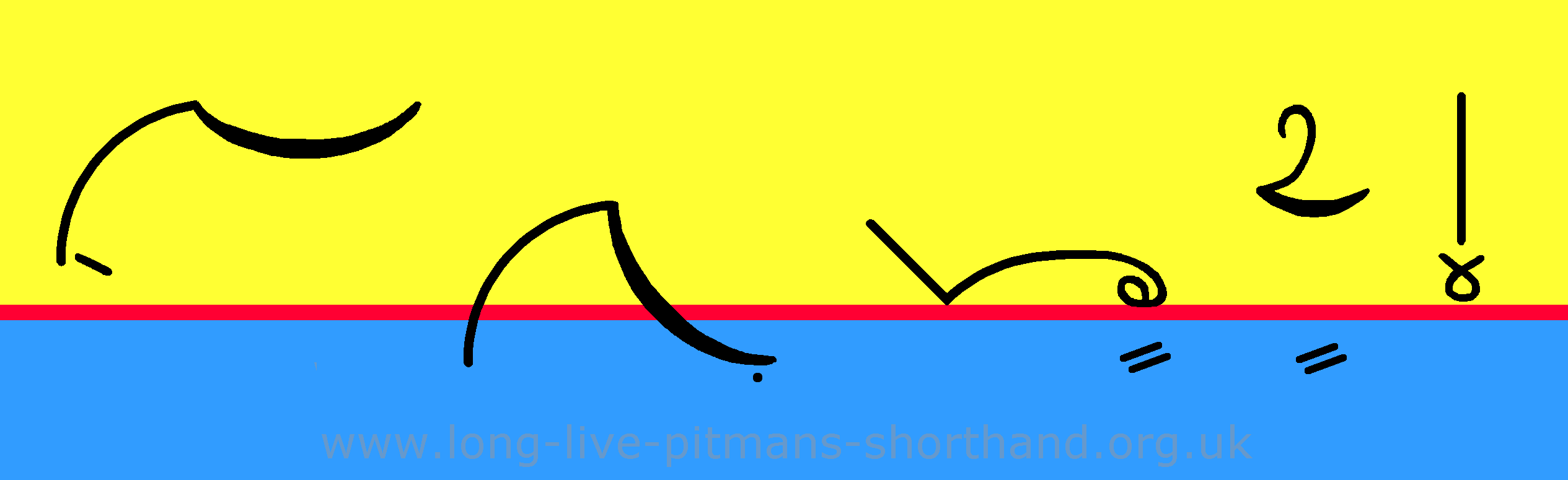
    Pitman's New Era: Fahrenheit x 2

Greenwich Park - Royal Observatory - height above sea level plaque

Pitman's New Era Shorthand Reading: Greenwich para 24

24. The second plaque shows the height above sea level as 154.7 feet, compared with the benchmark which is measured and maintained by the National Tidal and Sea Level Facility at their tidal observatory in Newlyn, Cornwall. This organisation is responsible for monitoring sea levels in the UK to assist with flood warnings, navigation and climatology. As coincidence would have it, this is a little more than the height of the main mast of the Cutty Sark ship above her deck, at 146 feet, giving pause for thought as you look down the hill and imagine that the tiny figures on the grass below are walking about on the ship's deck, with you perched aloft! (114 words)

  • benchmark: stroke Em intersected for "mark"

  • UK: The shorthand shows this spoken as the letters of the alphabet "yoo-kay". For the full words, see placename list at end of Contractions Optional page

Greenwich:  Part 1 - Part 2 - Part 3 - Part 4 - Part 5 - Part 6

Top of page


"Whatever is true, whatever is noble, whatever is right, whatever is pure, whatever is lovely, whatever is admirable – if anything is excellent or praiseworthy – think about such things." (Philippians 4:8)

HELP FIND MISSING CHILD MADELEINE McCANN:

www.findmadeleine.com/campaigns/age_progression.html "Madeleine is now 8 years old. These ‘age-progression’ images have been produced by experts at NCMEC, Washington. They are a guide as to what Madeleine may look like now."

Missing child Madeleine McCann age progression photos


The code to embed this YouTube is available at www.ceop.police.uk (Child Exploitation and Online Protection Centre) who request as many web users as possible to propagate the video.

"The earnest, heartfelt, continued prayer of a righteous man makes tremendous power available, dynamic in its working." James 5 v 16 (Amplified)

 
Free Guestmap from Bravenet.com


Pitman's Shorthand Guestbook with fountain pen

I invite you to view or comment in my Guestmap (started May 2009, 90+ comments)
and/or
Guestbook (started July 2011)
Both take comments, and with the map you can also leave a pin in your location.
Your entry will be monitored before it appears. Please note personal replies cannot be undertaken, and contact info should be omitted. Please use the Guestbook to report mistakes in the shorthand - thank you.

http://uk.youtube.com/LucyPaintbox My videos of shorthand being written, and demos of Noodler's Flex Pen and the origami booklets.

All original material on this website is copyright © Beryl L Pratt and is provided for personal non-commercial study use only, and may not be republished in any form. If you wish to share the content, please do so by a link to the appropriate page of this website.

 
Free art reference photos at Lucy Paintbox

Long Live Pitman's Shorthand! logo web


Free art reference photos on my other website:
www.lucypaintbox.org.uk

My photos of Kent places:
www.panoramio.com/user/2590774

This website contains no advertising. If you see any, please reload at:
www.long-live-pitmans-shorthand.org.uk

Free Web Counter from www.statcounter.com

Free Guestmap from Bravenet.com