|
Intelligence + effort +
persistence = excellence
The theory
pages provide a compact and detailed reference source and are
designed to give more information than the average course book
provides. Their best use is for review and revision, after your
basic instruction is completed. I would encourage complete
beginners, who have no prior knowledge of Pitman's Shorthand, to
concentrate their primary efforts on the more simplified information
in their instruction book.
Course books do not go into minute detail, nor should they – the
student would get "theory indigestion" and probably give up, and the
textbook and course fee would double in size and cost. They, and
teachers, rightly present the information piecemeal, in a form much
more easily learned, and so the information here does not replace
that in any way.
Where suggested outlines are offered,
most of these do have the root word in the dictionary (large 1974
edition), and, where not, the suggestion is based on an existing
outline. I have not marked up every occasion where the outline was
not in the dictionary, as some are so basic that no note is
necessary.
The Rules
I have included explanations so that outline
decisions are not felt to be frustratingly arbitrary, but are seen
as honed for speed and reliability under pressure. I have given as
many examples as possible, to give you plenty of material to
practise with, and you can easily work out how similar words would
be written.
The basic rules
of the system cover most outlines, but there will always be
combinations of strokes that produce awkward outlines, or ones that
would not stand up to being written rapidly. Over the time since its
creation, experience has thrown up words that are better written "in
the exception" and consequently their departure from the general
rule has to be described. If only one word behaves like this, it is
called an exception; if there are several words, then their
behaviour gets to be enshrined as a subsidiary rule. Should a new
similar word arise, then there is a rule in place to deal with it.
It is just like
speaking English, people use words and sentences that are easy and
convenient, and they will use irregular pronunciations, verbs and
plurals without a second thought for the extra pages that
grammarians will have to write. Shorthand becomes the same as your
skill increases and new words (i.e. ones whose outlines you do not
know) are recognised as being based on ones
that you already know. This is the only way to write unfamiliar words
during dictation, with thoughts of theory kept for more leisurely
hours when you are correcting your shorthand.
In study hours, it is sometimes helpful to
construct that unknown outline, to exercise your theory skills.
Finding out for yourself what does and doesn't work prevents you
from feeling that outlines have been chosen arbitrarily. Sometimes
one stroke joins very well after another, and then the third stroke
cannot be joined at all, and you must backtrack on your choice. It
is great encourager when you have worked out the correct outline,
and that adds to your shorthand confidence. All this has, of course,
already been done by countless contributors and revisers over very
many years, not least by Sir Isaac Pitman himself who spent his
entire adult life considering all the outline possibilities. All
this effort and expertise is close to hand and at your fingertips in
the shorthand dictionary.
If the rules
were kept few and tidy, the shorthand itself would suffer from
unclear, straggling or hard-to-write outlines that would deteriorate
at speed. There is one overriding rule that covers all the "rule
breaking" – the outlines must conform to:
-
Facility
– easy to
write
-
Legibility
– easy to read
-
Lineality
–
maintaining horizontal writing, not invading the lines above or
below
To quote Sir
Isaac Pitman himself from his Manual of Phonography of 1852
para 91:
"For any given word, the writer
should choose that form which is most easily and rapidly written,
and is at the same time distinct. The briefest outline to the eye is
not necessarily the most expeditious to the hand. The student will
insensibly* acquire a knowledge of the best forms by practice and
observation, and he will derive much assistance from perusing the
"Phonographic Correspondent," and other phonetic shorthand
publications. In deciding between two or more outlines for any word,
he should adopt that which unites the greatest degree of facility,
with a capability of intelligible vocalization."
*"insensibly" here is an older use of
the word, meaning "imperceptibly, unconsciously"
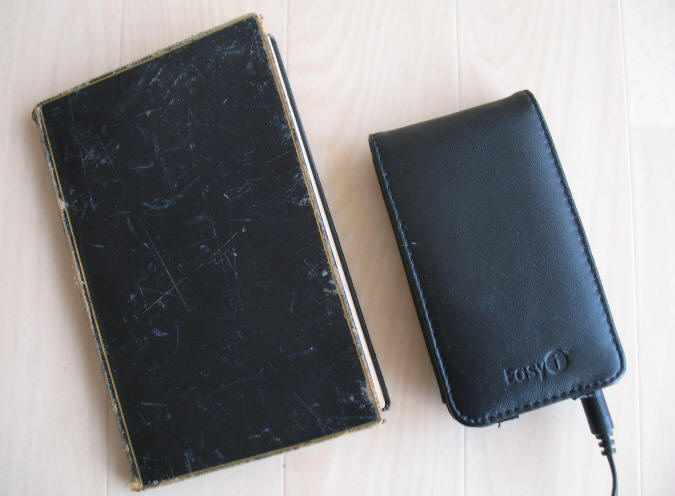
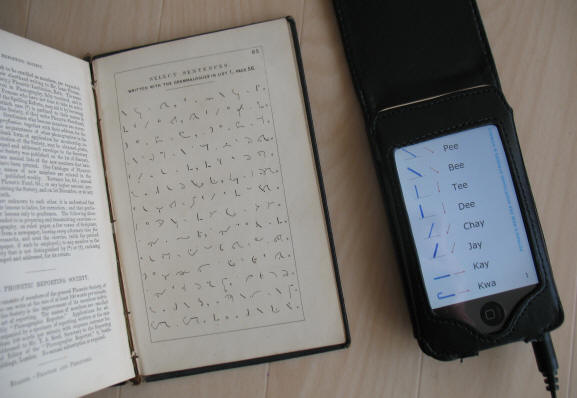
From I-SAAC to I-POD in 158
years!
Information on various instruction books is now on page
Shorthand Books
New Era
I do not believe New Era is
particularly difficult to learn, if you enjoy your learning. It is beneficial to learn the theory from your instruction book as
quickly as your time available allows (without sacrificing
thoroughness and practising of matter learned) in order to reduce
the time spent suffering the frustration of only being able to write
some words and not others. The theory on this website is best used
for subsequent review and revision, or filling in points that you
did not understand from the textbook if you do not have a teacher to
ask.
I started office shorthand work
with a speed of 120 wpm and I feel this is a good figure to aim for,
so that you are not struggling all the time, and can maintain
reasonably neat shorthand rather than an embarrassed sprawl. All
speeds up to that are highly commendable, as they will have been
gained through hard (and enjoyable) work, but in real life people
seldom speak at less than 100 wpm. Any slowness in the overall speed
comes from the pauses, rather than the laboured, even dictation that
shorthand learners become accustomed to. It is good to practise fast
bursts, with pauses after, which is more lifelike. Getting too far behind
the speaker takes away all enjoyment of using your hard-won and
valuable skill, and you might be called upon to read back
immediately rather than escape to your desk to mull over the
outlines!
Secretarial courses of shorthand and typewriting at the time I
learned them (1970's) were considered more lowly manual skills for
those less able in academic terms. There was not the slightest
perception that it was difficult, just something utterly basic to be
learned by those "destined" for the lowlier jobs. My shorthand
classmates arrived at college with this attitude already in place,
unaware that they were doing such a disservice to their own
intelligence and capabilities. However, I believe everyone's
self-esteem increased rapidly throughout the college year. Having
gained exam passes for both the "higher" (academic) and "lower"
(commercial) subjects, I can confirm that I found the "lower"
definitely more enjoyable, practical and useful throughout life.
(More on college shorthand experiences on my
About page).
Shorthand is only seen as
difficult nowadays because it is less well-known and the assumption
is often made that a rare skill has to be a difficult one. It is
rare only because it is not requested by employers as it was in
previous years. That rarity could be an advantage if you can list
shorthand on your CV, but there is also the necessity to make known
your possession of this skill. A computer desktop picture of some
shorthand outlines may be in order – see the
JPGs for Ipod, use part of
the Flying
Fingers poster JPG, or indeed any shorthand JPG on this website.
On my course we learned all the
theory in the first term from September to December and the other
two terms were spent on speed practice and gearing up to various
shorthand exams. This course included other commercial subjects, so
shorthand was not taking 100% of study time. Our successes came from maintaining our interest and enthusiasm throughout that year, and of
course our patient and kindly shorthand teacher who encouraged
everyone equally. Often interest grows as one learns a subject,
novelty turns into familiarity, and then into usefulness.
Shorthand requires precision and exactitude to be done well, and
you cannot "waffle" your way through exam answers or the
production of verbatim transcripts. It is better to study and
prepare well, rather than find out the hard way that employers are
not amused by errors or omissions in the transcript or report. It is a
skill that is a source of great
satisfaction once one has learned it to a useful level, even
if exams are never undertaken.
Whatever
shorthand you use, it is a worthy achievement, both in the skill
gained and the bravery of facing unknown dictation at unknown
speeds, totally unruffled and with the confidence that you can get
it all and transcribe correctly. Your first public arena for using
this skill may be via the telephone message pad, but rest assured it will not go unnoticed for long.
Pitman 2000
This is a simplified version of
New Era. It was introduced in 1971 as "Pitman Shorterhand", which
was dropped soon after in favour of the name Pitman 2000. It has
slightly fewer rules and omission of many short forms
and contractions. The purpose was not to "improve" New Era but to
make shorthand easier and quicker to
learn for those who do not aspire to the highest speeds. Against the
advantage of easier learning, there is the disadvantage that some
outlines are longer, and some joins between strokes are allowed that
New Era discourages as being not so easy to form, or less reliable under
the stress of speed. At lower speeds, this may not be an issue, and
confidence in the formation of the outline may possibly make up for
this. It was not intended to replace New Era, but was aimed at
office workers who generally do not need the speed that a verbatim
writer or reporter might need. However, even office dictation, e.g.
letters and reports, has to be verbatim, but a person dictating in
an office will probably speak somewhat more slowly, and with more
pauses, than someone
speaking to other people and not directly to the shorthand writer.
Any writer of Pitman 2000 could
benefit from the shorter forms of New Era if they wish to seek out
and adopt them. Teachers must give the theory as it stands, and
students may be marked on their outlines in exams, but outside of
that, writers are free to adopt any forms they find useful,
preferably after learning the entire system and with a reasonable
amount of experience
of real-life shorthand writing as well. New Era and 2000 writers
alike can benefit from the advanced outlines and phrases offered in
books by high speed writers. Books on other shorthand systems can
often yield useful pointers on abbreviating principles and study
methods.
Top of page
|