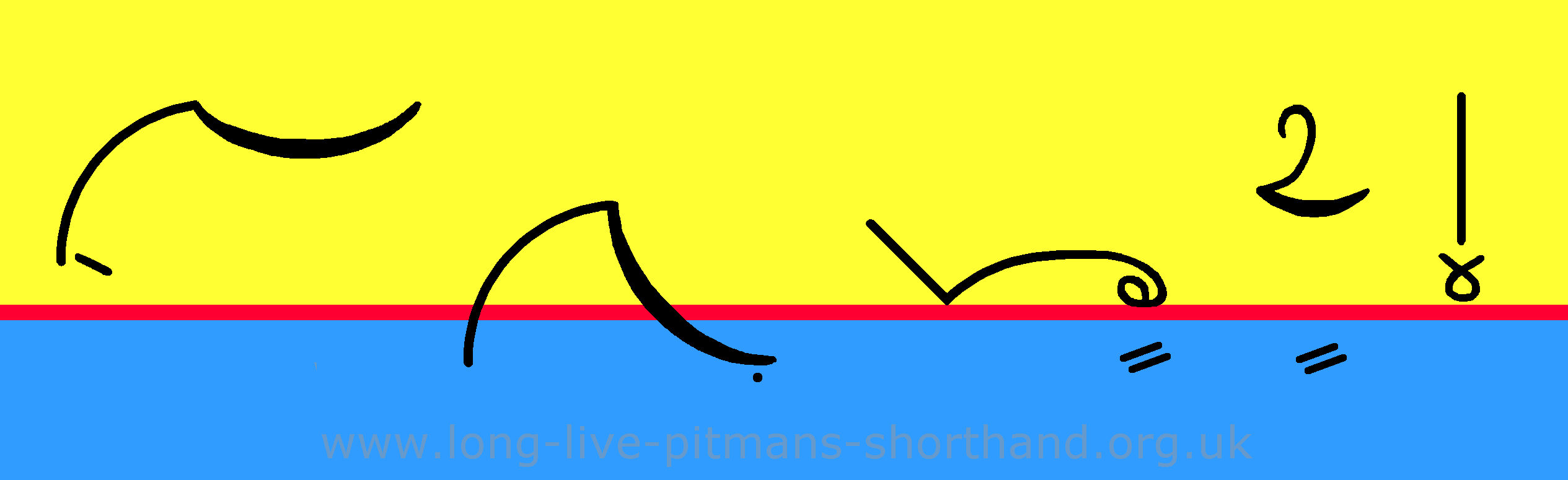
You are thinking of learning shorthand and you don't know if you
have what it takes or whether it is worth the effort. I hope these
pages provide some of the information needed for you to answer those
questions, before you go out and buy expensive books that may end up
gathering dust.
We all learned longhand without doing any theory, facility drills or
speed tests – incentive and practice brought results, greatly helped
by being surrounded by the printed word. I remember reading why
children are often better at solving computer problems than their
parents – the answer was given that "they have plenty of time and
they didn't pay for the computer" i.e. persistence and a relaxed
attitude.
Time
Imagine filling in a vast spreadsheet but having to write all the
numbers as full words.
Imagine cutting the lawn with a pair of scissors.
Imagine cleaning your entire home with one cotton bud.
Imagine all the phone numbers had 100 digits.
Imagine walking to work with both your shoelaces tied together.
Imagine running for a bus in a pencil-thin ankle-length skirt.
Imagine filling your bath with a teaspoon.
Imagine swimming in treacle.
Imagine cycling through sand.
This is how the shorthand writer feels when obliged to revert to
longhand. Writing longhand averages 20-30 wpm. A good typist may
average 50-60 wpm, some much more. Shorthand of 80 wpm is a
praiseworthy achievement for a student after a course of study, and
120 wpm deserves a box of chocolates/health shop carob bar. Normal
speech can easily reach 200 wpm, and a writer who has 250 wpm
deserves every penny of the wages earned. 350 wpm is believed to be
the fastest speed attained in a timed test – this was by Nathan Behrin in 1922 when, I assume, he would have been using Pitman's
Centenary Shorthand, the immediate predecessor to Pitman's New Era:
http://query.nytimes.com/mem/archive-free/pdf?res=9D0CE1DE1730E433A25753C3A9649D946395D6CF
This link takes you to the New
York Times Archive PDF showing the cutting from 30 December 1922
describing the contest. Note that he not only wrote at 350 wpm, he
transcribed it – the important part!
http://query.nytimes.com/mem/archive-free/pdf?_r=1&res=9A07E3DA123CE633A25752C2A96E9C946396D6CF
Reporting another shorthand
contest in August 1912.
http://www.ncra.org/About/content.cfm?ItemNumber=11462&navItemNumber=11230
A short history of the National Speed Contests held at Lake George,
New York, from the National Court Reporters Association.
http://www.loc.gov/pictures/item/npc2007011966/ A photo from
1924 of high speed writers Charles Swem (Gregg), Nathan Behrin
(Pitman) and Solomon Powsner (Pitman) seated at a table with their
shorthand pens and pads at the ready.
A20 Sidcup Bypass
Shorthand lane on the left,
longhand lane on the right
If you write very rapid longhand, think how good you will be at
shorthand. Try the numeral test at the top of the Beginners page.
Time how long it takes you to write all these longhand words:

We-thank-you for-your-letter and your application form for-the post
of secretary.

harmonious usefully well-known necessary
personal customer
I think you could probably
trace over the above outlines faster than you can write the
longhand versions, even without knowing anything about shorthand or
what sound each mark or shape stands for. Have a go at the above using this
Try
Your Speed PDF (137 KB), tracing very lightly in pencil over the printed
marks. One word per second = 60 words per minute,
already two or three times faster than longhand. A clock with a loud tick
makes a good one-second metronome.

It's all within reach – do the
work, get the results
Economy and convenience
More words for less ink, more text on less paper, less frustration,
less missing info. More can be written on the average seaside
postcard and the postman probably cannot read it!
Tape/digital recordings need transcribing, but your notes can stand
as they are, if you wish. You can go instantly to any part without
searching or rewinding. You can use anything that will make a mark,
on anything that will take a mark.
Apprentices need tools
"Be with you in a minute, Sir Alan." – "Yes Sir, I've got that,
would you like me to recap, Sir?"
Batteries run down and may fail at an inconvenient moment. Your
batteries are much nicer – it's called food (PS: keep the quality up
– fast food means slow shorthand).

Accuracy
In your conferences, meetings and telephone calls you can take notes
and get down exactly as much as you need to. Longhand will never
keep up with the spoken word and while you are scribbling the
longhand, the next lot of words is going over your head. Shorthand
frees you to listen and take part, without losing any information.
How many other executives at that meeting will get all the notes
that you do? While they are fiddling with their digital recorders
(which will faithfully record all the extraneous noises, scraping of
chairs, stirring of teacups, and irrelevant chitchat) followed by
waiting for their secretary to transcribe the notes, you are acting
on your information and have already moved on to the next
assignment.
Top of page
Inspiration
When inspiration comes, you need to be able to put it down exactly,
and then refine later. If someone else were writing it for you, you
would be frustrated at having to wait for them to catch up. If you
are writing the longhand yourself, the frustration is the same. You
need to catch those ideas at the rate they are arriving. You can
actually write shorthand on the bedside notepad in the dark at 1 am,
and go back to sleep soundly, knowing it is all down in black and
white. Just make sure you use pencil for this, and not your precious
fountain pen.
"Buy more
shorthand books!"
Good ideas at 1 am
Satisfaction
Learning something challenging brings huge satisfaction. If it is
not actually useful, this satisfaction can fade. Shorthand will
never do that, in fact it increases as greater facility is obtained
and using it gets easier and easier. When shorthand is the norm, and
longhand a pain to use, you will have arrived.
Another side to this is the realisation how much the hand and mind
can be trained, like obedient and willing slaves, to do tasks for
you. Training your servants to do your bidding, and watching them
happily jump into action is most gratifying – and useful.
Boot sale car exit in a field
Make the rut work for you, as you train your mind and hand to
produce shorthand on demand
Employment
Job prospects are improved – not only for the shorthand that you can
use, but a prospective employer will realise that you are someone
who can buckle down and learn things. They will assume your English
skills are good, that you pay attention to detail and that your
attention span is longer than the average. A shorthand writer has to
have solid concentration and listen closely, all good points in your
favour.

Working for royalty
Top of page
Open Doors
A new skill can often lead you to do things that would not otherwise
have been open to you. People with shared skills are more likely to
swap information, contacts, and ideas.
Priory Gardens, Orpington, Kent
New vistas
Fitness
Shorthand is very different from other academic studies. In the
attitude required, it is more like sport or fitness training. You
take on a racing mentality, not against others but to get all the
words down with no gaps. At the end of your studies, your mind will
not be sluggish. It is the difference between stumbling bleary-eyed
out of bed and a short while later emerging from the shower, fresh,
glowing and ready for action.
You do not have to be aiming at exams. You do not have to put
yourself through any speed trials at all. You can benefit from
shorthand without any of that hassle if you so wish. Even slow
shorthand is going to be a lot faster than longhand. But I would
caution a home learner that unhelpful habits in shorthand need a
teacher's eye to pick up on, before they become ingrained, and slow
writers do tend to draw and dig, rather than write. However, a
certificate with YOUR NAME on it does validate all your hard work in
a way that nothing else can.
(PS: Take the camera!)
View from the top is worth the climb
Blue Bell Hill, Rochester, Kent
Persistence
It teaches you to pay attention to a multiplicity of small things
that may keep you from achieving your goal. Shorthand has been
designed and perfected over the years to decrease time and effort,
and increase reliability, ease of writing and legibility. You end up
with the same mindset, looking for hindrances to prune away and
improvements you can take on board, and you carry over this attitude
to your other activities. "Many a mickle makes a muckle"
Ant excavations
Grain by grain . . . Persist-Ant!
Top of page
Privacy
People often mention this, mainly in regard to writing their diary
or Christmas present list. This is good fun and entirely in line
with using your shorthand for everything. You need never lose those
precious thoughts and memories, and you can get more into the
average diary.
For real-life confidential stuff in your employment, you need to
know that a shorthand person will most definitely be able to read
outlines upside-down as well and they don't all wear a Shorthand Hat to
identify themselves, so guard your office dictation pad from
unauthorised eyes and never leave it lying around.
My handwritten shorthand dictionary in an A-Z phone book
Top secret diary
Pen Enthusiasts
There are only so many daily
writing tasks that you can use your treasured pen collection for –
letters, cards, albums, shopping lists, calligraphy for your friends
– and then you are eagerly looking for something else to write. Real
useful writing is what the pens themselves actually want, you only have to ask them and they will tell you so . .
.
Between starting shorthand and
finishing the instruction book (and beyond) you can fill scores of
shorthand notebooks with beautiful flowing outlines, the best use
for that bouncy flexible nib with the juicy ink flow.* You can work
through your pens and inks at the speed of light (almost), leaving
no pen or ink bottle languishing on the shelf for long periods
awaiting its turn. With the increased volume of writing, more pens
can be inked and used in quick succession, without drying out, with
the added satisfaction of knowing that your inky playtime is
producing a useful skill. The only work involved is deciding which
pen and ink colour to use next, and maybe also actually stopping
writing in order to perform the rest of your daily duties!
*See my
Noodler's Flex
Pen review
The shape and thickness of
every outline is fixed and meaningful, so it cannot be embellished,
but they do have a calligraphic appearance that will satisfy the
artistic writer. Real handwritten shorthand is much more cursive
than the carefully drawn outlines in the textbook.
|
 |
|
"Why have-you been
learning shorthand? What train of-thought led to-your
sitting // down to-write for-the first time, perhaps only a
short time ago, such // forms as P B T D? The answer is,
I-feel sure, that either // you yourself or your mother
and-father believed that a knowledge of-shorthand offered //
(you very good opportunities for
future employment, employment in which you would find both
profit and pleasure)." |
Emily D Smith's
cursive and neat shorthand (250 wpm writer) in "The Expert
Shorthand Writer". Her entire book is written in shorthand, using
only the 700 Common Word list. The shorthand would be even more
cursive if written from dictation, rather than prepared carefully
for publication.
My own pens have blue for
website outlines, red for revising drafts, sepia in a hard-nibbed
pen for longhand notes, and green, turquoise and purple just for a
change of ink scenery – all accompanied by some talks on the Ipod,
where I can either snatch alternate sentences from fast speaking,
or, if slower, make an effort to get a whole chunk with no gaps in
the shorthand.
Coloured rubber bands on the ends to show ink colour
Not a hoard of expensive pens, but instead
some very favourable Ebay bargains, plus a cheapie, and two from old
college days in the 1970's.
Wow Factor
Impressing your friends? As the book/film character Mary Poppins
said, "Oh well, if we must, we must!"
A longer-lasting and more generous variety is when you teach your
friends some of the "squiggles" and they say the Wow in delight at
writing their name in shorthand. When they come back for more, you
may have a whole new career ahead of you. But do finish the course
book first, please!
The other Wow Factor is more subtle and not expressed out loud.
Skill and reliability never go unnoticed and when things get tough
and "the rubber meets the road" – whose name will come to mind when
a job vacancy needs filling?
Speed at any cost?
Shorthand speed without accuracy or reliability. Would you employ
this driver?
Anti-theft street advert
Apt description of the advantages of a shorthand
website
Top of page |